Comprehensive Cybersecurity Technologies Guide 2026: Modern Enterprise Protection
Navigating modern digital risk requires adopting robust cybersecurity technologies that protect critical data, secure cloud workloads, and preserve business continuity. As organizational infrastructure moves toward decentralized, multi-cloud environments, traditional security perimeters no longer offer adequate defense. Threat actors constantly scan subnets, exploit zero-day vulnerabilities, and launch automated attacks against corporate networks.
Every modern enterprise must establish a clear, resilient defensive posture. Security is no longer limited to basic antivirus software or simple network firewalls. It serves as a fundamental operational requirement that safeguards business operations, protects customer privacy, and satisfies dynamic regulatory standards.
This guide explores core defense frameworks, advanced protection tools, and practical operational strategies needed to secure modern infrastructure.

Essential Cybersecurity Technologies for Modern Defense
Securing corporate assets against persistent cyber threats demands a multi-layered defense strategy. Relying on a single line of security leaves infrastructure exposed when an adversary bypasses initial access controls.
Combining continuous monitoring, automated analysis, and identity verification creates a defensive mesh that withstands continuous probing.
Identity and Access Controls
Identity has become the primary defense boundary across modern cloud ecosystems. Managing user access effectively stops the vast majority of initial breach attempts.
Multi-Factor Authentication (MFA) remains a baseline security requirement. However, basic SMS and push-notification systems remain vulnerable to interception and fatigue attacks. Organizations are transitioning toward phishing-resistant standards like FIDO2 hardware keys.
Privileged Access Management (PAM) tools restrict administrative control across high-value servers and databases. PAM platforms enforce just-in-time access provisioning, ensuring credentials expire immediately after a task finishes.
Identity governance solutions run continuous background checks on active accounts. Automated workflows revoke excess access rights when employees change internal roles or leave the organization.
Network Segmentation and Zero Trust
Static perimeter security assumes everything inside the corporate network is safe. Modern architectures discard this assumption and enforce strict validation for every network request.
Micro-segmentation divides broad corporate networks into small, isolated zones. If an attacker breaches a single workstation, micro-segmentation prevents them from moving freely toward core financial databases.
Zero Trust Network Access (ZTNA) replaces legacy virtual private networks (VPNs). Instead of granting broad network-level visibility, ZTNA grants users context-aware access only to specific authorized applications.
Continuous session evaluation monitors user behavior throughout active working sessions. If a user account suddenly exhibits abnormal location changes or unusual data downloads, access privileges adjust automatically.
Key Categories of Modern Cybersecurity Technologies
Enterprise security requires specialized tools operating across every layer of the technology stack. Deploying integrated solutions ensures technical teams maintain full visibility across endpoints, application interfaces, and cloud environments.
| Security Layer | Primary Technologies | Operational Focus |
| Identity & Access | FIDO2 Tokens, PAM, IAM Solutions | Enforce least-privilege access and phishing-resistant authentication. |
| Endpoint Security | EDR, XDR, Automated Quarantine | Monitor device behavior, isolate compromised nodes, and kill malicious processes. |
| Cloud & Application | CSPM, WAAP, Container Scanning | Audit cloud configurations, block API abuse, and scan software images. |
| Data Protection | Post-Quantum Cryptography, HSMs | Encrypt data at rest and in transit, manage master keys securely. |
Advanced Endpoint Detection and Response
Endpoints represent primary attack targets for malware, ransomware, and credential harvesting scripts. Traditional signature-based antivirus solutions fail against newly created or polymorphic malware.
Endpoint Detection and Response (EDR) software continuously monitors device process trees, memory allocations, and network sockets. When suspicious activity occurs, EDR agents isolate the affected system from the network immediately.
Extended Detection and Response (XDR) expands endpoint telemetry by correlating security events across network gateways, email systems, and cloud infrastructure. Aggregating these signals gives security analysts a complete view of active threats.
Automated containment playbooks allow security platforms to respond instantly to high-confidence threats. Stopping an execution chain in seconds reduces the operational impact of unexpected ransomware intrusions.
Cloud Posture and API Security
Rapid adoption of cloud platforms introduces dynamic configuration risks. Misconfigured cloud resources, such as public storage buckets or open administrative ports, invite automated exploitation.
Cloud Security Posture Management (CSPM) tools inspect cloud deployments continuously against established security baselines. When a configuration drift occurs, CSPM platforms send instant alerts or trigger automated remediation routines.
Web Application and API Protection (WAAP) solutions defend external application interfaces against common exploits, web scraping, and denial-of-service attempts. Advanced WAAP platforms analyze API payload structures to stop broken object-level authorization attempts.
Container security utilities scan software container images for known vulnerabilities before deployment. Runtime protection tools track container processes in production to ensure unauthorized binaries do not execute.
Emergent Cybersecurity Technologies and Future Readiness
As threat vectors evolve, defensive strategies must adapt to protect long-term digital assets. Preparing for future technological shifts ensures organizations remain secure against emerging attack methods.
Machine Learning in Threat Detection
Security Operations Centers (SOCs) manage thousands of security alerts daily. Security Information and Event Management (SIEM) systems leverage machine learning algorithms to reduce alert fatigue.
Machine learning models establish normal baseline behavior for every network host and user profile. When host activity deviates significantly from established norms, the system elevates the threat score for analyst review.
Automated incident correlation links disconnected security events across different network layers. Grouping related alerts into a single incident timeline helps security teams identify multi-stage attacks faster.
Behavioral analytics also assist in detecting insider risks. Sudden bulk file downloads or off-hours database queries flag immediate notifications for security investigation.
Cryptographic Agility and Post-Quantum Security
Advancements in quantum computing threaten legacy public-key encryption standards such as RSA and ECC. Organizations handling long-lifespan data must prepare for cryptographic transitions today.
Cryptographic agility involves maintaining a precise inventory of where encryption algorithms operate across enterprise software, hardware appliances, and database systems.
Deploying post-quantum cryptography standards published by official standards bodies like NIST ensures critical data remains safe against future decryption attempts.
Key lifecycle management tools automate the regular rotation of master encryption keys. Protecting master keys inside Hardware Security Modules (HSMs) prevents key extraction during system breaches.

Cyber Incident Response and Practical Resilience
Even advanced defensive controls can face determined attack attempts. Organizations require clear, practical incident response plans to contain intrusions and maintain business operations.
Operational resilience measures an organization’s ability to withstand active security incidents without suffering catastrophic downtime or data loss.
The Incident Management Lifecycle
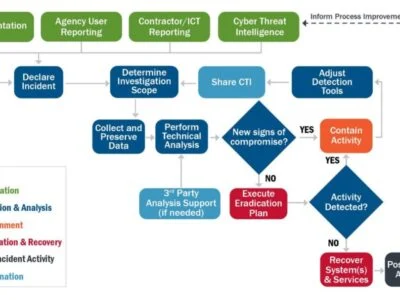
Managing security incidents effectively requires following a structured, repeatable operational process.
- Preparation: Develop clear incident response playbooks, establish communication channels, and assign specific response roles to technical staff.
- Detection and Analysis: Analyze system logs, confirm breach boundaries, and determine how adversaries gained initial access.
- Containment: Isolate compromised network segments, revoke compromised user tokens, and block malicious IP addresses.
- Eradication: Remove malicious code, patch exploited software vulnerabilities, and rebuild affected host environments from trusted images.
- Recovery: Restore operational systems safely, verify security controls, and monitor system telemetry closely as services come back online.
- Lessons Learned: Document lessons learned, analyze root causes, and update defensive configurations to prevent similar incidents.
Data Backup and Immutability Strategies
Reliable backup systems serve as the ultimate defense against destructive ransomware and data-wiping campaigns. Organizations must protect backup files from being encrypted or deleted during an incident.
Adopting the standard 3-2-1-1-0 backup strategy provides strong recovery assurances. Maintain 3 separate data copies across 2 different storage media types, with 1 copy stored off-site and 1 copy stored completely offline in an immutable format.
Immutable storage uses write-once-read-many (WORM) parameters. Immutable configurations prevent administrative accounts or malicious actors from modifying backup files once written.
Testing restore procedures regularly ensures backup data remains valid and recovery time objectives (RTOs) are realistic.

Governance, Risk Management, and Compliance
Maintaining technical security controls must align with legal, regulatory, and corporate governance requirements. Integrated compliance frameworks ensure transparency and operational accountability.
Organizations should consult guidance from public security agencies such as CISA to align internal controls with established industry standards.
Data Privacy and Regulatory Frameworks
Global data privacy regulations impose strict rules on how organizations gather, process, and retain personal customer data.
Mandatory breach notification laws require reporting data leaks to regulatory bodies within defined windows, often within 72 hours of discovery. Failing to report breaches promptly can lead to severe regulatory fines.
Continuous compliance monitoring replaces legacy point-in-time annual audits. Automated tracking tools generate real-time compliance logs across cloud assets and local servers.
Data sovereignty laws require clear data localization strategies. Organizations must ensure sensitive customer records remain within approved geographical boundaries and comply with local encryption laws.
Key Operational Security Metrics
Security leaders must evaluate technical performance using clear, business-focused metrics rather than raw system activity numbers.
- Mean Time to Detect (MTTD): The average time required for technical teams to identify an active security compromise inside the network.
- Mean Time to Respond (MTTR): The average time taken to isolate threats and contain active security incidents.
- Patch Latency: The time gap between vendor patch releases and actual enterprise deployment across operational systems.
- Third-Party Risk Score: Aggregated security ratings evaluating vendor systems and software dependencies.
Communicating security performance in clear operational terms helps executive leadership allocate resources to high-priority security initiatives.

Conclusion
Securing enterprise environments requires a balanced, practical strategy that combines robust identity management, continuous visibility, automated response playbooks, and strict access controls. As threat vectors expand, organizations that adopt Zero Trust principles, deploy post-quantum readiness measures, and maintain tested recovery plans will protect digital assets effectively. Focus on core operational hygiene, automate routine security tasks, and build strong security habits across every level of the organization.