Cyber Incident Response Playbook: Step-by-Step Defense Framework
A structured Cyber Incident Response Playbook is an essential operational requirement for modern enterprises. When a breach occurs, IT security teams need precise, pre-approved action plans rather than improvised decisions. Rapid threat containment minimizes system downtime, protects sensitive customer records, and preserves corporate reputation.
Security teams face sophisticated attack tactics daily, ranging from automated ransomware scripts to targeted credential harvesting. Having a clear playbook ensures that incident response teams identify vector breaches quickly, isolate compromised systems, and restore business workflows safely.
This guide provides a comprehensive framework for constructing and executing an enterprise-grade incident response program.

What Is a Cyber Incident Response Playbook?
A Cyber Incident Response Playbook is a detailed, standardized procedure document that outlines specific operational steps security personnel must take during a cyber attack. It converts high-level cybersecurity policies into actionable tasks.
Unlike general security guidelines, a playbook defines specific roles, escalation protocols, and isolation steps tailored to distinct threat scenarios.
Why Every Organization Needs Incident Playbooks
Relying on informal response procedures during an active security breach leads to critical errors. Security analysts may misinterpret system logs, fail to isolate infected endpoints, or delay reporting breaches to legal authorities.
- Speed of Execution: Pre-defined workflows allow teams to contain attacks within minutes, limiting network damage.
- Consistency: Standardized tasks ensure every team member follows identical security standards during high-stress situations.
- Regulatory Compliance: Regulatory frameworks like GDPR and HIPAA require documented, repeatable incident handling mechanisms.
Core Phases of the Incident Response Lifecycle
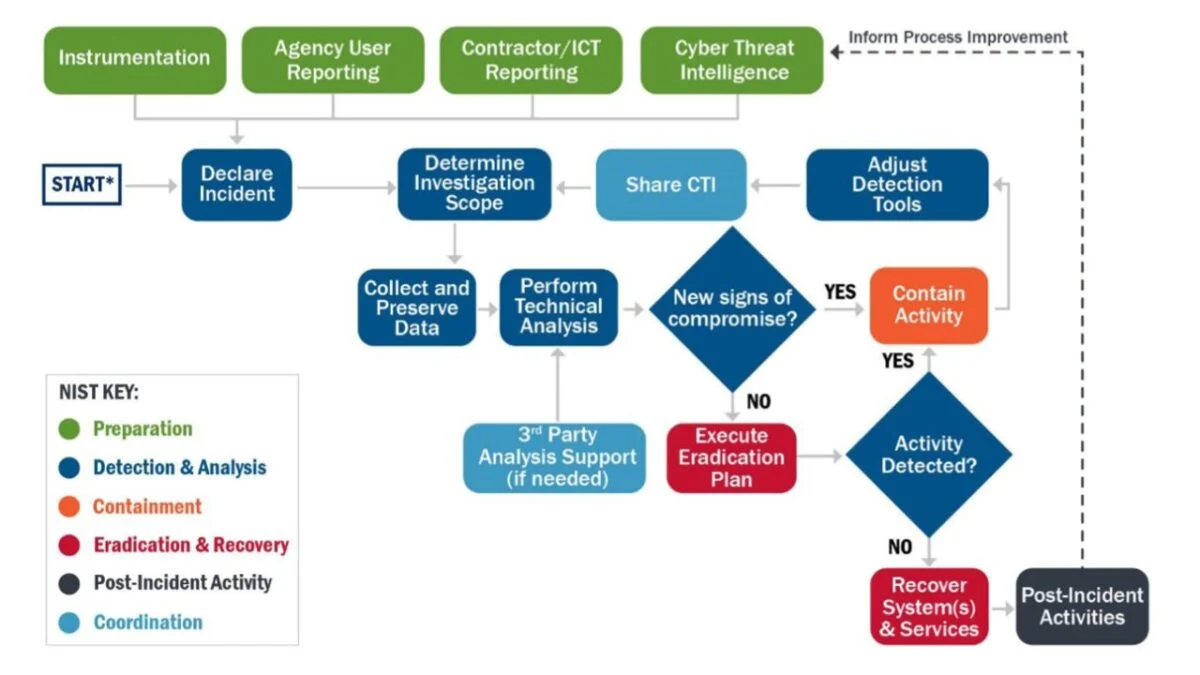
An effective playbook follows the standardized incident handling lifecycle defined by leading security organizations such as NIST and CISA.
+-------------------------------------------------------------------+
|               INCIDENT RESPONSE LIFECYCLE PHASES                  |
+-------------------------------------------------------------------+
|  1. Preparation                                                   |
|     - Asset Inventory, Tooling Deployment, Team Training          |
+-------------------------------------------------------------------+
|  2. Detection & Analysis                                          |
|     - Telemetry Correlation, Alert Triage, Scope Definition       |
+-------------------------------------------------------------------+
|  3. Containment, Eradication & Recovery                           |
|     - Host Isolation, Threat Removal, Clean System Restoration    |
+-------------------------------------------------------------------+
|  4. Post-Incident Activity                                        |
|     - Root Cause Analysis, Playbook Updates, Policy Tuning        |
+-------------------------------------------------------------------+
Phase 1: Preparation
Preparation forms the foundation of all incident handling. Without proper monitoring tools, asset inventories, and credential controls, effective response is impossible.
Security teams must maintain accurate inventories of all network hardware, cloud storage buckets, and software dependencies. You cannot protect or isolate an asset you do not know exists.
Deploy Centralized Logging solutions and Endpoint Detection and Response (EDR) agents across all hosts. Ensure log retention policies preserve historical data for at least 90 days to support forensic analysis.
Establish out-of-band communication channels. If an attacker compromises the primary corporate email system, the response team needs isolated communication tools like encrypted messaging channels to coordinate response efforts.
To explore how these preparation measures connect to broader organizational security layers, check out our comprehensive cybersecurity guides for deeper technical insights.
Phase 2: Detection and Analysis
Detecting an intrusion requires continuous monitoring across network perimeters, endpoints, and identity providers.
Automated alerts from Security Information and Event Management (SIEM) systems flag suspicious anomalies, such as unusual off-hours logins or mass file modifications.
- Alert Triage: Security analysts verify whether an alert represents a true positive breach or a false positive operational activity.
- Scoping: Determine the total number of compromised accounts, systems, and network subnets.
- Entry Point Identification: Trace attack telemetry back to initial access mechanisms, such as phishing emails or unpatched edge devices.
Document every finding meticulously. Precise timestamps, IP addresses, and hash values are critical for subsequent forensic investigations and legal reporting.
Phase 3: Containment
Once an active threat is verified, containment is the immediate priority to prevent lateral movement across adjacent subnets.
- Short-Term Containment: Isolate infected endpoints from the physical network while keeping system power on to preserve volatile RAM memory.
- Long-Term Containment: Revoke compromised user tokens, reset account passwords, and apply temporary firewall blocks to malicious IP addresses.
Avoid deleting virtual machines or wiping drives immediately upon discovery. Preserving evidence allows forensic investigators to determine whether sensitive data was exfiltrated.
Phase 4: Eradication and Recovery
Eradication focuses on removing all traces of the adversary from the environment.
Security teams must locate and remove backdoor persistence mechanisms, secondary admin accounts, and malicious scheduled tasks left by attackers.
Rebuild compromised systems from verified, clean master images rather than attempting to clean heavily modified system files. Apply all missing security patches before bringing systems back online.
During recovery, restore data from immutable backups, re-engage network connections incrementally, and monitor system telemetry closely for secondary infection signals.
Phase 5: Post-Incident Activity
The response process does not end when systems return to production. Post-incident analysis provides valuable data to strengthen long-term defenses.
Conduct a formal “Lessons Learned” meeting within two weeks of incident closure. Review response timelines, identify procedural bottlenecks, and address gaps in tool coverage.
Update the Cyber Incident Response Playbook based on real-world performance metrics to ensure continuous improvement.
Key Scenarios Covered in Incident Playbooks
Organizations should develop dedicated playbooks for specific, recurring threat categories.
| Threat Category | Primary Detection Indicators | Critical Action Steps |
| Ransomware | Bulk file extension changes, disabled shadow copies, ransom note drops. | Isolate host immediately, block C2 IPs, verify immutable backup integrity. |
| Credential Abuse | Multiple failed logins followed by successful access from unusual locations. | Revoke active user sessions, enforce MFA reset, audit active session tokens. |
| Data Exfiltration | Large outbound data transfers via unauthorized protocols or cloud services. | Terminate connection, block destination IP, audit exfiltrated file logs. |
| Supply Chain Attack | Unauthorized process execution initiated by trusted third-party software updates. | Quarantine updating service, revoke vendor access, review vendor hashes. |
Frequently Asked Questions
What is the difference between a Cyber Incident Response Playbook and an Incident Response Plan?
An Incident Response Plan is a high-level strategic document defining roles, legal obligations, and communication rules. A Cyber Incident Response Playbook is a tactical, step-by-step guide detailing technical actions for specific threats.
How often should an incident playbook be updated?
Playbooks should be reviewed and updated at least annually, or immediately following any major security incident, infrastructure change, or new threat intelligence release.
Who should be included in the Incident Response Team?
The team should include IT security analysts, system administrators, legal counsel, public relations officers, and executive decision-makers.
Why is volatile memory (RAM) capture important during containment?
Volatile RAM contains active encryption keys, running malware processes, and unsaved network connections that disappear once a computer is powered off.
How do immutable backups protect against ransomware?
Immutable backups use write-once-read-many (WORM) parameters, preventing ransomware applications from encrypting or deleting stored backup files even with administrative credentials.
Conclusion
A well-structured Cyber Incident Response Playbook serves as an indispensable operational blueprint for modern enterprise security. By establishing clear preparation protocols, rapid containment steps, and thorough eradication workflows, organizations can mitigate severe technical risks and limit operational downtime. Security threats will continue to evolve, but teams that commit to regular playbook testing, continuous monitoring, and post-incident learning can defend critical infrastructure effectively and preserve operational resilience.