
The five-on-five format represents the most popular and fast-paced variation of non-contact football played around the globe. Designed to emphasize agility, strategic pass concepts, and rapid ball distribution, this version eliminates heavy physical line play in favor of open-field athletic competition. Understanding the specific regulations that govern this format helps teams build efficient offensive schemes while maintaining disciplined defensive positioning throughout match play.

Official international competitions and recreational leagues alike follow structured frameworks managed by international governing bodies such as the International Federation of American Football (IFAF) to ensure standard play. The compact nature of the field requires quick decision-making from every athlete. With fewer players on the gridiron, open grass becomes a primary strategic asset that teams must exploit or defend on every down. Major sporting locations like , , , , and local recreational venues like regularly showcase athletic events that rely on strict rule enforcement and proper field alignment.
Field Dimensions and Roster Organization in 5v5 Flag Football Rules
Mastering official 5v5 flag football rules begins with understanding how the playing space is structured and how teams manage active rosters during competition. Unlike traditional full-sized gridirons, this format uses a streamlined field layout that keeps energy high and minimizes downtime between snaps.
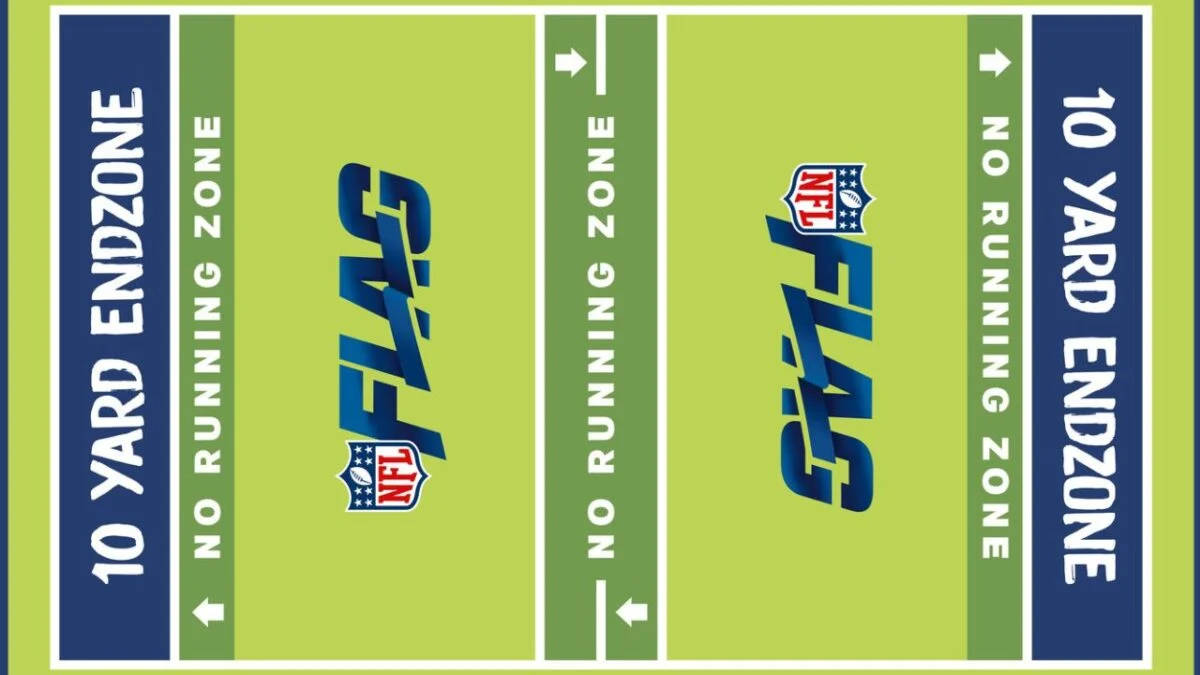
The standard playing area measures fifty yards long by thirty yards wide, complemented by two end zones measuring ten yards deep each. This creates a concise sixty-yard total field length where offensive drives move rapidly toward scoring positions. Midfield serves as the single first-down line, dividing the playing space into two distinct twenty-five-yard halves.
Roster limits usually allow up to twelve active players, though only five athletes take the field at one time. Frequent substitutions keep players fresh during high-tempo possessions. Coaches can make substitutions between any dead-ball play, provided the incoming player steps onto the field before the next snap occurs.
Position assignments in this format are fluid and athletic. Every offensive athlete except the quarterback functions as an eligible receiver downfield. Defensive units typically rely on versatile backs who can switch between man coverage and deep zone responsibilities on short notice.
Offensive Structure and Passing Guidelines
Offensive possessions in five-on-five play move quickly due to strict timing parameters placed on the quarterback. Teams start their drives at their own five-yard line after touchbacks or scores, with four downs to cross the midfield mark for a fresh set of downs.
The play sequence begins with a direct snap from the center to the quarterback. Once the snap is complete, a seven-second pass clock begins counting down immediately. The quarterback must throw a forward pass or execute a handoff before those seven seconds expire, ensuring the game maintains a continuous, energetic pace.
The line of scrimmage marks the spot where every play originates. The center must snap the ball between their legs or laterally to the quarterback to begin the action. A clean snap is critical because any fumbled ball that touches the turf is declared dead immediately at that spot, resulting in a loss of down.
Quarterbacks operate under a strict seven-second pass clock counted by field officials. If the quarterback does not throw a forward pass or hand the ball off within seven seconds, the referee blows the play dead. This results in a loss of down, and the ball returns to the previous line of scrimmage.
Running plays are permitted in open space, but direct quarterback runs across the line of scrimmage are prohibited unless a handoff occurs first. Once a handoff takes place behind the line, any player can attempt a run or throw a forward pass from behind the original line of scrimmage.
No-run zones represent a critical structural boundary located five yards before midfield and five yards before each goal line. When an offense enters these five-yard areas, they are restricted entirely to passing plays. This rule eliminates dangerous short-yardage physical charges near critical scoring lines.
Executing passing schemes under short clocks requires great timing between receivers and quarterbacks. High-stakes sporting events regularly showcase how fast-moving tactics unfold under tight field boundaries. Readers looking for deeper insights into competitive tournament structures can explore the official FIFA World Cup 2026 Round of 16 Bracket to see how tactical discipline drives championship teams.
Defensive Regulations and Rush Mechanics
Defending in the five-on-five format demands disciplined positioning, sharp footwork, and precise flag pulling techniques. Without physical tackling, defenders must focus on closing down space quickly while avoiding illegal physical contact with ball carriers.
The defensive alignment centers around the rush line, which officials establish seven yards behind the line of scrimmage prior to every snap. The primary rusher must start completely behind this seven-yard mark to be eligible for an immediate pass rush against the quarterback. Remaining coverage backs align downfield to cover eligible receivers or guard designated zone areas.
To pressure the passer, defensive rushers must line up at least seven yards behind the line of scrimmage when the ball is snapped. Field officials mark this seven-yard rush line before every down. Only defenders who start behind this mark at the snap are eligible to cross the line of scrimmage to rush the quarterback immediately.
If a defender lines up inside the seven-yard mark, they cannot cross the line of scrimmage until a handoff or lateral pass occurs. Once a handoff takes place, all defensive players can rush across the line to pursue the ball carrier.
Flag pulling is the defender’s primary tool to stop forward progress. The spot where the flag belt detaches from the runner’s waist marks the exact location for the next line of scrimmage. Grabbing a runner’s clothing, shorts, or jersey while attempting a flag pull results in a defensive holding penalty.
If a runner’s flag belt falls off naturally during a play before receiving a pass, the player remains eligible to make a catch. However, once the player controls the football, the play is blown dead immediately at the spot of the catch. Official equipment standards maintained by NFL FLAG outline how belts must be secured to maintain fair competition.
Scoring Systems and Extra Point Conversions
Scoring in five-on-five flag football follows a structured point system designed to reward consistent offensive drive execution. Understanding the different ways to score enables coaches to make strategic decisions during critical moments of a match.
A touchdown is worth six points and is awarded when a player carries the ball across the opponent’s goal line or catches a pass inside the end zone. Following a touchdown, the scoring team does not kick an extra point. Instead, they must attempt an extra point conversion play from scrimmage.
Teams can choose between two distinct extra point conversion options based on risk and field positioning. Attempting a conversion from the five-yard line yields one point if successful, but the offense must execute a passing play because the five-yard mark falls inside the no-run zone.
Alternatively, teams can choose to attempt a two-point conversion from the ten-yard line. From this distance, the offense has full tactical freedom to run or pass the ball. Deciding whether to aim for one or two points often depends on game clock management and late-game score margins.
Defensive teams can also score during extra point attempts. If the defense intercepts a pass during a one-point or two-point try, they can return the ball all the way to the opposite end zone to earn two points for their team.
Safeties provide another scoring opportunity for the defense, yielding two points plus possession of the ball. A safety occurs when a ball carrier is tagged or has their flag pulled inside their own end zone, or when an offensive penalty occurs within the end zone boundaries.
Common Penalties and Game Violations
Maintaining fair play and player safety requires strict enforcement of penalty rules. Referees penalize both offensive and defensive infractions by assessing yardage losses or replaying downs.
Flag guarding is one of the most frequent offensive violations called during competition. It occurs when a ball carrier uses their hands, arms, elbows, or the football itself to swipe away a defender’s hand or shield their flag belt. Flag guarding results in a five-yard penalty assessed from the spot of the foul, along with a loss of down.
Illegal contact penalties apply to both sides of the ball. Offensive players cannot push off defenders to create space while running routes, nor can they charge directly into a stationary defender. Defensive players cannot tackle, trip, body check, or forcefully grab an opponent. Personal fouls carry a ten-yard penalty and can lead to player ejection for repeated infractions.
False starts and illegal motion fouls happen before the ball is snapped. All offensive players except one moving parallel to the line of scrimmage must remain set for at least one full second before the snap. A false start immediately stops the play and costs the offense five yards.
Defensive pass interference occurs when a defender makes physical contact with a receiver to impede their ability to catch a forward pass. Penalty enforcement places the ball at the spot of the infraction with an automatic first down for the offense.
Illegal rushing happens when a defensive player crosses the line of scrimmage before the seven-yard rush mark is cleared or before a handoff occurs. Referees penalize illegal rushing with a five-yard penalty added to the end of the play or replayed down options.
Game Clock Management and Overtime Rules
Efficient clock management is a decisive factor in close matches. Matches consist of two twenty-minute halves, with a brief halftime break separating the periods.
The game clock runs continuously throughout the first nineteen minutes of each half, stopping only for official timeouts or injury delays. Each team receives two designated timeouts per half to halt the clock and regroup strategically.
During the final minute of the second half, the game shifts to stop-clock regulations. The clock stops for incomplete passes, out-of-bounds plays, scoring plays, change of possession, and official penalty assessments.
If a game ends in a tie after regulation play, competition enters an overtime period. A coin toss determines which team receives first possession or selects which end zone to defend during the extra period.
Each team receives one possession starting from the opponent’s ten-yard line to score a touchdown and complete an extra point conversion. If both teams score equally during their initial possessions, overtime continues until one team outscores the other in matching possession rounds.
Frequently Asked Questions (FAQs)
What are the main 5v5 flag football rules for running plays?
Running plays are allowed anywhere on the field except within five-yard no-run zones near midfield and goal lines. Quarterbacks cannot run directly across the line of scrimmage unless a handoff occurs first.
How does the seven-second pass clock work in 5v5 flag football rules?
The quarterback has exactly seven seconds from the snap to throw a forward pass or hand the ball off. If seven seconds expire without a pass or handoff, the play is dead, resulting in a loss of down.
Who can rush the quarterback under 5v5 flag football rules?
Only defensive players who line up at least seven yards behind the line of scrimmage at the snap can rush the quarterback immediately.
What is a no-run zone in 5v5 flag football rules?
No-run zones are five-yard areas located directly before midfield and each end zone where teams must execute passing plays to prevent short-yardage power running.
How many downs does an offense get in 5v5 flag football rules?
An offense gets four downs to cross the midfield line. If they cross midfield, they receive a fresh set of four downs to score a touchdown.
What is flag guarding in 5v5 flag football rules?
Flag guarding occurs when a ball carrier uses their hands, arms, elbows, or the football to block a defender from pulling their flag. It carries a five-yard penalty from the foul spot and a loss of down.
Are kickoffs used in 5v5 flag football rules?
No, traditional kickoffs are not used. Offenses start their drives at their own five-yard line at the start of halves and after scores or touchbacks.
What happens if a fumble occurs during play?
Fumbles are declared dead immediately when the ball touches the ground. The team maintaining possession keeps the ball at the spot of the drop and loses the down.
Conclusion
Understanding 5v5 flag football rules allows players and coaches to compete safely, strategically, and efficiently. By mastering field positioning, pass clocks, non-contact defensive rushing, and point conversions, teams can build effective game plans suited to this fast-paced format. For a broader look at foundational concepts, field dimensions, and equipment setups across all formats, explore our main Flag Football Rules guide. Continuing to practice these standard regulations ensures rewarding, fair, and high-level athletic performance on every possession.


[…] Rules & Beginner’sCricket Formats Explained: Ultimate Guide to Test, ODI & T205v5 flag football rulesFlag Football Rules: Complete Guide for Beginners (2026)How to Build a Cyber Incident Response […]