
How to Tennis Scores Work
Here is how to tennis scores work. In tennis, scores move from points to games, then to sets, and finally to the match result. This progression tells you who is winning at each stage. The first paragraph answers the core question, and the rest of the article will break down each part of the system. You’ll learn the meaning of love, deuce, tie‑breaks, and why a match can end in three or five sets. By the end you should feel comfortable following any match on TV or at the court.
Understanding tennis scoring starts with the smallest unit: the point. Because the point names are unusual, many new fans get confused early on. For example, a score of 15‑30 looks like a math problem, but it simply reflects the order of points won. Then the game moves to the next level once a player reaches four points with a two‑point lead. This article will show you how each step builds on the previous one.
Next, the article explains how games combine into sets. While a set usually ends at six games, there are special cases like a 7‑5 set or a tie‑break at 6‑6. You’ll also see why some tournaments use best‑of‑three while others use best‑of‑five. The goal is to give you a clear picture of why the numbers change the way they do.
A closer look
After the set rules, we will cover common mistakes that beginners make. For instance, many people read the scoreboard backwards or mix up game and set scores. We will point out these errors and suggest ways to avoid them. Then you’ll know how to double‑check a score so you never doubt what you heard.
Finally, the guide includes a short FAQ and a concise conclusion. The FAQ answers the questions you’re most likely to ask after watching a match. The conclusion gives one simple rule of thumb to remember whenever you see a tennis score. With this knowledge, you can enjoy matches without feeling lost.
How to tennis scores work: the basic components

What you need to understand before you start
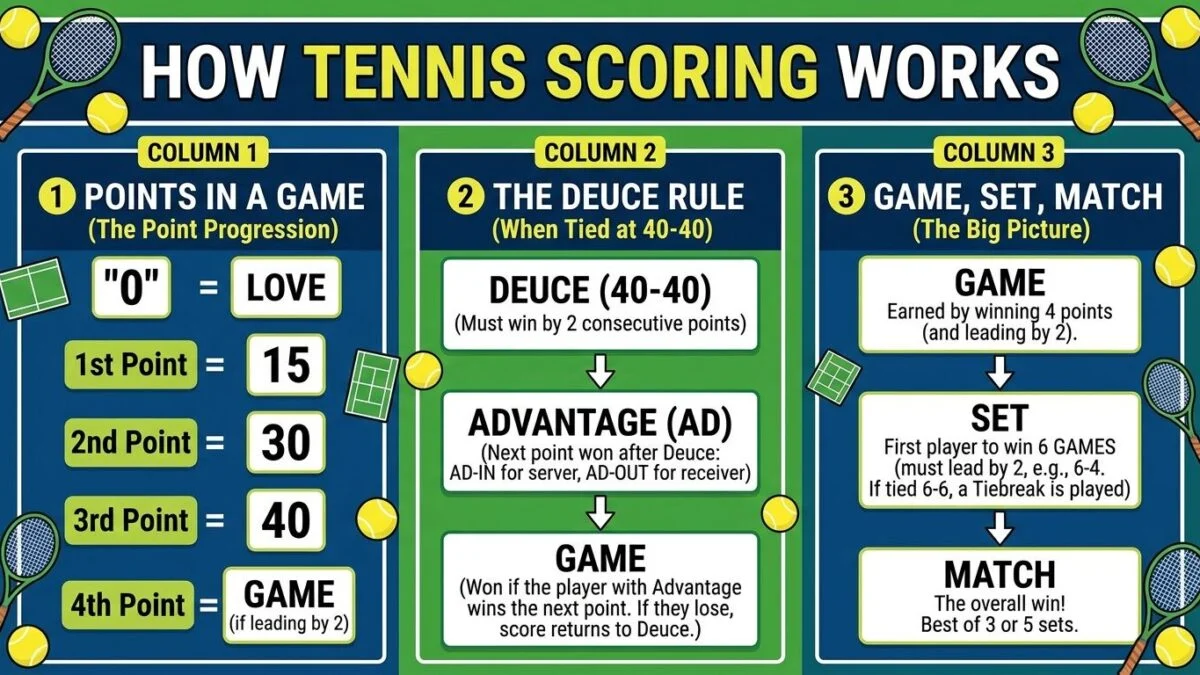
Before you can follow a match, you should know three key terms: point, game, and set. A point is the smallest unit and is announced as love, fifteen, thirty, or forty. A game is won when a player secures at least four points and leads by two. A set consists of a collection of games, usually needing six games with a two‑game margin. For a full overview of the official rules, see the tennis rules page on our site. (en.wikipedia.org)
How are points counted in a game?
From love to forty‑five and beyond
Points start at love, which simply means zero. The first point won becomes fifteen, the second thirty, and the third forty. If a player wins the fourth point while leading by two, the game ends. However, if the score reaches forty‑all, the game enters a special phase called deuce. This system may seem odd, but it dates back to old clock‑face scoring.
What happens at deuce and advantage?
When the score is deuce, each player must win two consecutive points to claim the game. The first point after deuce gives the player “advantage.” If the same player wins the next point, the game is over. Otherwise the score returns to deuce, and this back‑and‑forth can continue indefinitely, though most matches resolve quickly. The deuce rule ensures a clear two‑point margin before a game is awarded.
How does a game become a set?
Winning six games and the two‑game margin
A set is usually won by the first player to reach six games with at least a two‑game lead. For example, a 6‑4 score satisfies the margin, while 6‑5 doesn’t. If the score reaches 5‑5, players continue until one leads by two games. This rule keeps the set competitive and prevents premature endings. The official scoring guidelines are detailed on the USTA scoring rules page.
Tie‑breaks and their scoring
When a set reaches 6‑6, most tournaments use a tie‑break to decide the set. In a tie‑break, points are counted numerically (1, 2, 3…) rather than using love‑fifteen‑thirty‑forty. The first player to reach seven points with a two‑point lead wins the tie‑break and the set 7‑6. If the margin isn’t achieved, play continues until the two‑point gap appears. This format speeds up matches while preserving fairness.
How is a match decided?
Best‑of‑three versus best‑of‑five formats
Matches are typically played as best‑of‑three or best‑of‑five sets. In a best‑of‑three, the first player to win two sets claims the match. Grand Slam men’s singles use best‑of‑five, requiring three set wins, and the format influences player stamina and strategy, especially in long tie‑breaks. Knowing the format helps you anticipate how many sets might be played. (on.com)
When a match ends early
Sometimes a match ends before the scheduled number of sets due to retirement, injury, or a walk‑over. In such cases, the opponent is declared the winner regardless of the current score. The official record notes the reason for the early finish. This situation is rare but important to recognize when you see an unfinished scoreline.
Common mistakes when reading tennis scores
Confusing game score with set score
One frequent error is mixing up the game score inside a set with the overall set score. For instance, a scoreboard showing 3‑2 might refer to games in the current set, not the number of sets won. To avoid confusion, always check the context: if the numbers are low, they likely represent games; if they’re higher, they may indicate sets. Clarifying the context prevents misinterpretation.
Misreading tie‑break numbers
During a tie‑break, the score is shown as a single number, such as 6‑4, rather than the usual love‑fifteen‑thirty‑forty format. Beginners sometimes think the first number is a game score, which leads to mistakes. Remember that tie‑break points are counted sequentially and the winner must have a two‑point lead. This awareness makes the transition from games to tie‑breaks smoother.

How to verify that you recorded the score correctly
Cross‑checking with the scoreboard
After you write down a score, compare it with the official scoreboard or the broadcast overlay. If the numbers match, you can be confident in your record. If they differ, double‑check whether you noted a game or a set score. This quick verification step catches most errors before they become a problem.
Using official scoring sheets
In tournament play, officials fill out a match record that includes point‑by‑point details. Access to these sheets, either online or at the venue, provides a reliable reference. For casual play, you can use a simple notebook and follow the same format as the official sheets. Keeping a consistent record helps you track progress and review past matches.
Frequently Asked Questions
What does 40‑30 mean?
It means the server has won three points (40) and the receiver has won two points (30) in the current game.
Why is there no zero point in tennis?
The term “love” is used instead of zero; its origin is unclear but it has been part of the sport for centuries.
Can a set end at 7‑5?
Yes, if the score reaches 6‑5 and the leading player wins the next game, the set ends 7‑5 without a tie‑break.
How does a super tie‑break work?
In some doubles matches, a “match tie‑break” to 10 points replaces a third set; the player must win by two points.
Conclusion
Understanding how tennis scores work boils down to remembering the sequence: points, games, sets, then match. If you keep those four layers in mind, you can follow any match without getting lost. A useful rule of thumb is to ask yourself whether the numbers you see refer to points, games, or sets before interpreting them. Next time you watch a match, apply this check and the flow of the game will become clear.

[…] Bandung: Fast Train & Best RoutesUnderstanding the Modern Economy: Trends, Growth & FutureHow to Tennis Scores WorkBig Tech Companies Overview, Impact, and RegulationTennis Rules Explained: Easy Guide to Scoring […]