
Understanding Tennis Rules: A Complete Guide
When you search for tennis rules, you expect a clear picture of how the game works. This article answers that expectation by breaking down the core concepts, scoring methods, and common pitfalls. By the end, you’ll know what to expect on the court and how to avoid simple mistakes. The guide is written for beginners who have never held a racket and for experienced players who need a quick reference. Remember, if you have specific legal or safety concerns, consult a qualified professional.
The sport of tennis has a long tradition, yet its rulebook stays surprisingly concise. Because the rules aim to keep play fair and enjoyable, they cover everything from how a serve is executed to what constitutes a code violation. For example, the International Tennis Federation updates the official rules each year to reflect modern equipment. Still, the basic structure has remained stable for decades, making it easier to learn.
Knowing the rules helps you focus on strategy rather than guessing what is allowed. When you understand why a point was awarded or lost, you can improve your decision‑making during rallies. Also, spectators benefit from a clearer view of the action, which makes matches more exciting to watch. In fact, many clubs require members to pass a short quiz on the rules before granting court access.
A closer look
This guide follows the natural flow of a match: it starts with the fundamentals, moves through the mechanics of play, and ends with the most frequent misunderstandings. First, we describe the court and basic scoring. Next, we explore how serves, faults, and lets fit into a rally. Then we look at variations for singles, doubles, and tie‑breaks. Finally, we debunk myths that often confuse newcomers.
Throughout the article you’ll find links to official resources for deeper study. For instance, the LTA provides a concise overview of rules and scoring that many beginners find helpful. The USTA also publishes a detailed explanation of tennis scoring. And the International Tennis Federation offers a downloadable PDF of the full rulebook. Use these references to verify any detail that seems unclear.
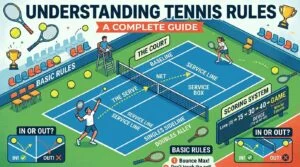
What are the basic tennis rules?

Court layout and equipment
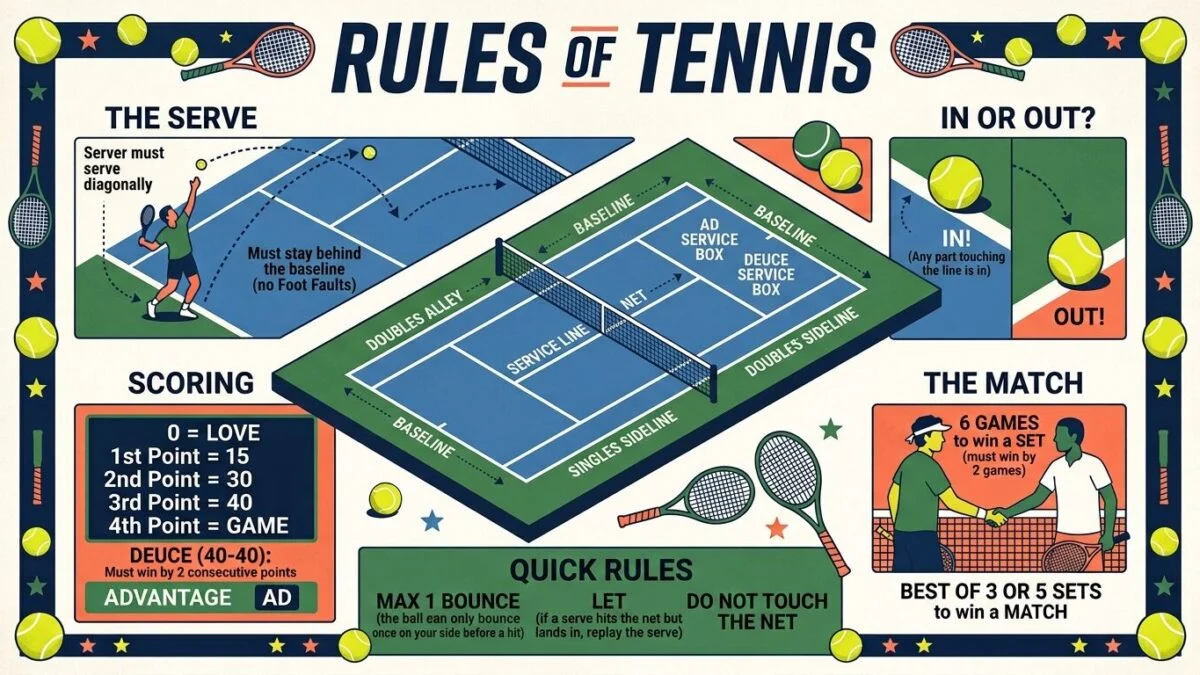
The playing surface is a rectangle 78 feet long and 27 feet wide for singles matches. Because doubles adds two more players, the width expands to 36 feet. The net divides the court at 3.5 feet in the center and slightly higher at the posts. Players must use a racket that conforms to size and string regulations, and the ball must be pressurized and of a specific diameter. In practice, most public courts follow these dimensions, making it easy to find a suitable venue. (lta.org.uk)
Scoring system basics
A game is counted as 0 (love), 15, 30, 40, and then game point. If both players reach 40, the score is called deuce, and a player must win two consecutive points to claim the game. A set consists of at least six games, but a player must lead by two games to win the set. For a quick reference, the LTA’s guide explains this sequence in plain language. The USTA site offers examples of how tie‑breaks affect set scores.
Understanding deuce and advantage
When the score reaches deuce, the next point gives the player “advantage.” If that player wins the following point, the game ends. Otherwise the score returns to deuce, and this back‑and‑forth can continue indefinitely, though most matches resolve quickly. Because the rule encourages competitive play, it adds drama to close games. Players often use a strong serve or aggressive shot to convert advantage into a win.
Where to find the official rulebook
The International Tennis Federation publishes the complete rules each year in a PDF document. This source includes detailed definitions of terms like “let” and “fault,” as well as the latest changes to equipment standards. You can download the 2026 edition from the ITF website for free. Reviewing the official text ensures you’re up to date with any recent amendments.
How does a tennis match work under the rules?
The short answer

Serving and receiving sequence
Each point begins with a serve from the right side of the baseline. The server must toss the ball overhead and strike it before it bounces. After a successful serve, the receiver returns the ball, and a rally ensues. If the serve lands in the correct service box, the point continues; otherwise it’s a fault. The server gets a second chance unless the first fault was a “let,” which requires a replay of the serve.
Faults, lets, and double faults
A fault occurs when the ball doesn’t land in the designated service box or the player misses the toss. If a fault happens on the first serve, the server may try again. A second fault on the same point results in a double fault, which awards the point to the opponent. A “let” is called when the ball touches the net but still lands in the service box; the serve is then replayed without penalty. Players must be aware of these distinctions to avoid losing points unnecessarily. (usta.com)
Changing ends and breaks
Players switch sides of the court after every odd-numbered game. This rule ensures that neither player is disadvantaged by wind or sun conditions. A 90‑second break is allowed between sets, giving competitors time to hydrate and receive coaching. In longer matches, a brief medical timeout may be granted if a player is injured. These pauses are built into the rules to maintain fairness and player welfare.
When and where are tennis rules applied?
Key details

Singles vs doubles play
In singles, each player covers the entire width of the court, while doubles adds a partner and expands the alleys. The basic scoring remains the same, but doubles uses a different serving order: each team member serves once before the turn passes to the opponents. Because the court is wider, players often aim for angles that would be out of bounds in singles. Understanding these differences helps you choose the right strategy for each format.
Professional tournaments vs recreational courts
Professional events follow the ITF rulebook to the letter, and officials enforce line calls, code violations, and time violations strictly. Recreational clubs may have more relaxed enforcement, but the core rules still apply. For example, a local league might allow players to self‑call “out” calls, yet still penalize double faults. Knowing the level of officiating you’ll encounter prepares you for both competitive and casual play.
Tie‑breaks and final set variations
A tie‑break is played when a set reaches 6‑6, and the first player to reach seven points with a two‑point margin wins the set. Some tournaments use a “super tie‑break” to decide a final set, where the target is ten points instead of seven. The rules for serving in a tie‑break differ: the first server serves one point, then the opponent serves two, and the pattern continues. These variations keep matches from dragging on indefinitely while preserving excitement.

What can and cannot be done according to tennis rules?
Allowed strokes and illegal actions
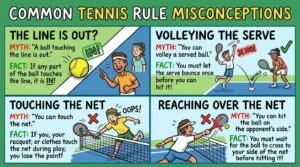
Players may hit the ball with any part of the racket face, as long as it’s struck before the ball bounces twice. However, a “carry” or “double hit” – where the racket contacts the ball more than once in a single motion – is prohibited. Reaching over the net to hit a ball is also illegal, even if the ball is on the opponent’s side. Understanding these limits prevents accidental rule breaches. (itftennis.com)
Code violations and penalties
The referee can issue a warning for misconduct such as shouting or racket abuse. A second offense results in a point penalty, and a third leads to a game penalty. In extreme cases, a player may be defaulted, meaning they lose the match. These penalties exist to maintain sportsmanship and protect the integrity of the game.
Equipment restrictions
The racket must not exceed 29 inches in length, and the strings can’t be attached to the frame in a way that creates a “trampoline” effect. Balls must meet specific weight and diameter standards set by the ITF. Players may not use substances on the racket that could affect ball spin. Checking equipment before a match ensures compliance with these rules.
What are common misconceptions about tennis rules?
Myth: You must win by two games
Many believe a set must end 6‑4 or 7‑5, but a tiebreak at 6‑6 can decide the set without a two‑game margin. This rule speeds up play in tournaments that use tiebreaks. Therefore, a set can end 7‑6 after a successful tie‑break. The ball is considered out only after it bounces twice on the same side of the net. If it bounces once on the opponent’s side and then again on yours, the point is over because the ball has already crossed the net.
Players sometimes confuse this with a “double bounce” rule that doesn’t exist. In professional matches, the chair umpire has the final authority, but line judges’ calls are respected unless challenged by a player using electronic review. In most amateur settings, players may discuss a call, but the umpire’s decision stands. This nuance clarifies who has the ultimate say on line calls.
Frequently Asked Questions
Do I have to announce the score before each serve?
Yes, the server must state the current game score, the set score, and the match score before serving. This practice helps both players stay aware of the match situation.
Can I challenge a line call in amateur play?
Most amateur matches don’t have electronic review systems, so challenges aren’t available. Players typically rely on the umpire’s judgment or agree on a call together.
How is a tie‑break scored?
Points in a tie‑break are counted numerically (1, 2, 3, etc.) rather than using love‑15‑30‑40. The first player to reach at least seven points with a two‑point lead wins the tie‑break and the set.
What happens if a player hits the ball before it crosses the net?
If a player strikes the ball before it has passed over the net, the point is lost immediately. This rule prevents players from reaching over and interfering with the opponent’s shot.
Conclusion
Understanding tennis rules equips you to play confidently, avoid penalties, and enjoy the sport fully. Remember the key steps: learn the court dimensions, master the scoring sequence, respect serving etiquette, and recognize common myths. For ongoing improvement, review the official ITF rulebook and practice the situations described here. By applying these fundamentals, you’ll be ready for your next match and able to focus on strategy rather than rule confusion.

[…] Breaking How to Tennis Scores WorkBig Tech Companies Overview, Impact, and RegulationTennis Rules Explained: Easy Guide to Scoring & Court Setupglobal politics ibScience Discoveries That Changed the WorldAI Detector: A Beginner’s Guide to […]