Asteroids and Planetary Defense: How Scientists Prepare for a Possible Impact
Asteroids and Planetary Defense
What Is Planetary Defense?
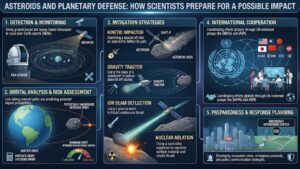
Asteroids and planetary defense are connected through one basic question: what can humans do if a space rock ever appears on a collision course with Earth? Planetary defense is the scientific effort to find, track, study, and assess near-Earth objects that could potentially create an impact hazard. NASA established its Planetary Defense Coordination Office in 2016 to coordinate much of this work, including asteroid searches, orbit calculations, impact monitoring, and research into possible ways to respond. (NASA Science)
Planetary defense does not mean that every asteroid near Earth is considered dangerous. Thousands of natural objects pass through Earth’s wider neighborhood, and most have no realistic chance of hitting the planet. The important task is to identify the smaller group whose orbits deserve closer attention. Scientists then continue observing those objects and update their calculations as new measurements become available.
This work involves much more than simply looking through a telescope. Researchers need to determine an asteroid’s orbit, estimate its size and physical properties, calculate future close approaches, and examine whether any possible trajectory could intersect with Earth. ESA follows a similar approach through its Planetary Defence Office and Near-Earth Object Coordination Centre, which provide orbit information, impact monitoring, and risk analysis. (European Space Agency)
Why Asteroids Can Become a Threat
Asteroids have been orbiting the Sun since the early history of the Solar System. Most remain far from Earth, particularly in the main asteroid belt between Mars and Jupiter. However, gravitational interactions and changes in their orbits can sometimes bring individual objects into Earth’s neighborhood.
For an impact to happen, an asteroid does not simply need to cross Earth’s orbital path. The asteroid and Earth must reach the same point at the same time. This is one reason why an asteroid can have an Earth-crossing orbit without actually being on an impact course. NASA explains that gravitational interactions with planets can gradually alter asteroid orbits, making long-term monitoring important. (NASA Science)
The size of an object also matters. Small asteroids can enter Earth’s atmosphere and break apart, while larger objects can survive deeper into the atmosphere or reach the surface with much greater energy. The 2013 Chelyabinsk event showed that even an object that exploded in the atmosphere could produce powerful shockwaves and damage across a wide area. Much larger impacts are extremely rare, but their potential consequences are one reason scientists take asteroid detection seriously. (European Space Agency)
How Scientists Find Near-Earth Asteroids
The first step in planetary defense is discovery. Telescopes repeatedly scan the sky and look for objects that move against the background of distant stars. When an unfamiliar moving object is detected, astronomers collect additional observations to determine whether it is a new discovery or an asteroid that has already been catalogued.
The first observations usually do not provide a perfect picture of the asteroid’s future. Scientists need multiple measurements taken over time to calculate its orbit with greater confidence. NASA’s Near-Earth Object Observations Program supports observations that help researchers discover NEOs and determine their orbits and physical characteristics. (NASA Science)
The information does not remain with one telescope or one research team. Observations from different observatories can be combined to improve the orbital calculation. The Minor Planet Center serves as an international hub for observations of asteroids and comets, while organizations such as NASA’s Center for Near Earth Object Studies and ESA’s NEO Coordination Centre use these observations for further analysis. (European Space Agency)
This is also why an asteroid’s discovery date is not the end of the story. Researchers may need to observe it again during later appearances or close approaches. Each additional measurement can help reduce uncertainty and provide a clearer picture of where the object will travel in the future.
Why Tracking an Asteroid Matters
Finding an asteroid is only the beginning. Scientists must continue tracking it because a short observation period can leave uncertainty in its predicted orbit. Even a small uncertainty in an asteroid’s current position or velocity can become more significant when researchers calculate its position many years into the future.
As new observations arrive, orbit models can be refined. An object that initially appears to have a small possibility of a close approach may later be shown to pass safely. The reverse can also happen, with new measurements identifying an object that deserves additional observations. This process is normal in asteroid monitoring and does not necessarily mean that the asteroid itself suddenly changed direction.
ESA’s NEO Coordination Centre uses observations collected from around the world to calculate asteroid trajectories and monitor possible impact risks. Its systems can update calculations as new observations are added, helping researchers distinguish between objects that simply pass near Earth and those that require more detailed investigation. (European Space Agency)
A real example of why continued observation matters is the history of individual near-Earth asteroids such as 1997 NC1. Studying specific objects helps explain how astronomers follow an asteroid’s orbit over time rather than relying on a single observation.
What Makes an Asteroid Potentially Hazardous?
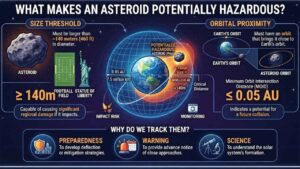
Scientists also use formal classifications to identify asteroids that deserve particular attention. One important term is Potentially Hazardous Asteroid, or PHA. According to NASA’s Center for Near Earth Object Studies, an asteroid currently falls into this category when its minimum orbit intersection distance with Earth’s orbit is 0.05 astronomical units or less and its absolute magnitude is 22.0 or brighter. (Center for NEO Studies)
The word potentially is important. Being classified as a PHA does not mean that scientists expect the asteroid to hit Earth. It means the object’s orbit and estimated size meet criteria that make continued monitoring scientifically important.
Scientists therefore separate classification from actual impact probability. A PHA can remain on a safe trajectory for many years, while its future path continues to be refined through additional observations. NASA and ESA maintain monitoring systems that assess these objects and update their calculations as new data becomes available. (NASA Science)
This distinction is useful because asteroid headlines can sometimes make a close approach sound more dangerous than it really is. A close approach means an object passes relatively near Earth by astronomical standards. It does not automatically mean a collision is expected.
Why Early Detection Gives Scientists More Options
Time is one of the most important resources in planetary defense. If an asteroid were discovered only shortly before a predicted impact, there would be fewer opportunities to study its size, shape, composition, and orbit or to prepare an appropriate response. A discovery made much earlier gives scientists more time to collect observations and improve their predictions.
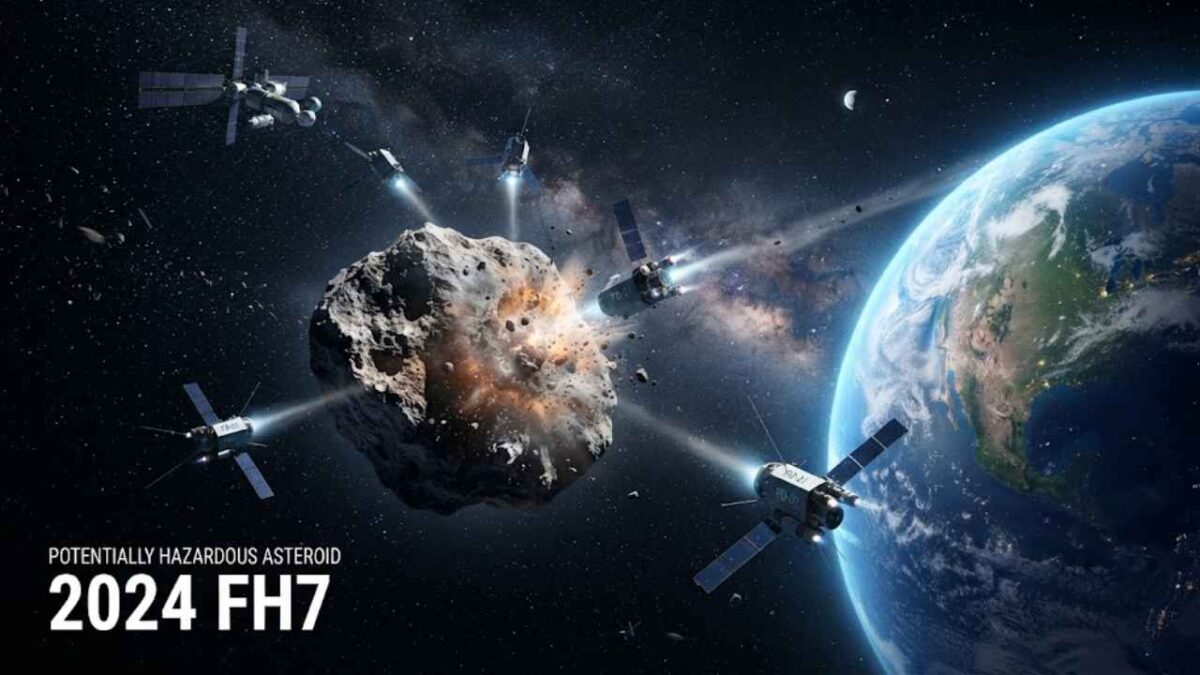
Early detection can also allow researchers to consider whether an asteroid’s path could be changed. NASA’s planetary defense program studies technologies for asteroid mitigation, including techniques that could alter an object’s trajectory. The DART mission demonstrated one such approach by deliberately impacting the asteroid moonlet Dimorphos, providing a practical test of kinetic impact technology. (NASA Science)
The goal, however, is not to wait for a dangerous asteroid and immediately launch a spacecraft. A possible response would depend on many factors, including the asteroid’s size, composition, orbit, warning time, and predicted impact location. Those details can only be understood properly when the object has been discovered and tracked well in advance.
That is why the foundation of Asteroids and Planetary Defense is detection and observation. Before scientists can decide how to respond to an asteroid, they first need to know that it exists, understand where it is going, and determine whether the apparent threat is real. The next stage of planetary defense begins when researchers move from monitoring an asteroid to considering how its trajectory could potentially be changed.
How Scientists Decide Whether an Asteroid Is a Real Impact Threat
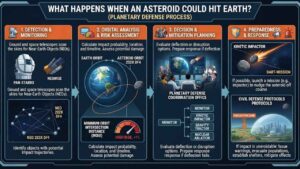
Once an asteroid has been discovered and its orbit has been calculated, scientists can begin asking a more important question: could it actually collide with Earth? This is where planetary defense moves from simple observation to risk assessment. Researchers use repeated observations, mathematical models, and information about the asteroid’s orbit to calculate where it could travel in the future. The result is not a single permanent prediction because the calculation can change as better observations become available.
Scientists pay particular attention to an asteroid’s close approaches to Earth. During these encounters, new observations can greatly improve the understanding of its orbit. Researchers also examine how the gravity of planets can influence an asteroid’s path over long periods. These calculations can extend decades or more into the future, depending on the quality of the available data.
An important part of this process is understanding uncertainty. If an asteroid has only been observed for a short period, there may be several possible orbits that fit the available measurements. As more observations are collected, the range of possible orbits usually becomes narrower. This allows scientists to determine whether a previously calculated impact possibility remains relevant or disappears as the orbit becomes better known.
What Happens When an Asteroid Could Hit Earth?
A possible impact would not automatically mean that an asteroid is going to strike Earth. Scientists would first need to confirm the object’s orbit and continue collecting observations. The amount of warning time would also make a major difference. An asteroid discovered decades before a possible impact would provide very different options from one discovered only weeks or months beforehand.
If a credible impact threat were identified, researchers would need to determine the asteroid’s physical characteristics as well as its trajectory. Its size, shape, mass, rotation, and composition could influence which response would be practical. An asteroid made of relatively solid material may respond differently to a spacecraft impact than a loosely assembled rubble-pile object.
The predicted impact location would matter as well. Scientists would continue refining the trajectory to determine where the object could potentially reach Earth. Governments and emergency organizations could then use increasingly accurate information for preparedness if necessary. The exact response would depend on the circumstances rather than following one fixed plan for every asteroid.
Can Humans Change an Asteroid’s Path?
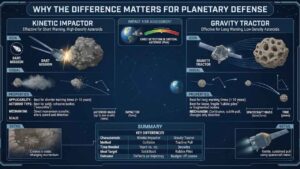
One of the most important ideas in planetary defense is that scientists do not necessarily need to destroy an asteroid. In some situations, changing its velocity by a very small amount could be enough to make it miss Earth years later. Because an asteroid travels through space for a long time, even a small change in its trajectory can eventually produce a much larger difference in its position.
NASA tested this concept through the Double Asteroid Redirection Test, better known as DART. On September 26, 2022, the spacecraft intentionally collided with Dimorphos, a small moonlet orbiting the asteroid Didymos. The mission demonstrated that a spacecraft could alter the orbital period of an asteroid moonlet through a kinetic impact. (NASA)
DART was a technology demonstration rather than an attempt to protect Earth from an actual threatening asteroid. Its importance came from showing that humans can deliberately change the motion of a celestial object. Scientists could then study the results to improve their understanding of asteroid deflection.
The mission also showed why knowing an asteroid’s physical structure matters. The amount of material thrown away from the impact helped increase the effect of the collision. This means that future deflection planning would require more than simply knowing an asteroid’s orbit. Researchers would need to understand the object itself.
Why Asteroid Deflection Needs Early Warning
An asteroid cannot usually be redirected at the last moment with a simple spacecraft mission. Deflection works best when there is enough time for a small change in velocity to accumulate into a meaningful change in the asteroid’s future position. The earlier a credible threat is identified, the more opportunity scientists may have to consider such an approach.
This is one reason planetary defense programs invest heavily in surveys and tracking systems. Finding an asteroid early may provide years or decades for additional observations and mission planning. It can also help researchers decide whether a deflection mission is even necessary.
A spacecraft mission would itself require considerable preparation. Engineers would need to select a suitable launch vehicle, design the spacecraft, determine how it would navigate to the target, and understand how the asteroid’s orbit could be altered. A mission would also need enough time to reach the asteroid before the relevant impact scenario.
DART provided valuable experience in this area, but one successful test does not mean the same method would work identically for every asteroid. Future missions and observations are needed to understand how different asteroid structures respond to impacts. Planetary defense is therefore developing through repeated scientific and engineering research rather than relying on one technology alone.
Asteroids Are Different From Space Debris
Planetary defense focuses primarily on natural objects such as asteroids and comets, but objects made by humans can also move through space and occasionally create unusual impact events. These objects are generally discussed as space debris, not asteroids. The distinction matters because their origins, orbital behavior, and potential responses are different.
Space debris includes inactive satellites, spent rocket stages, fragments from spacecraft, and other human-made material left in orbit. Most of it remains around Earth rather than traveling on the kinds of solar orbits associated with near-Earth asteroids. Tracking this material is another important area of space safety, but it should not be confused with natural asteroid monitoring.
For example, the planned or completed removal of inactive Starlink satellites is related to managing objects in Earth orbit rather than defending Earth from asteroids. Our coverage of SpaceX deorbiting 260 Starlink satellites provides a separate example of how human-made spacecraft can be deliberately removed from orbit.
The distinction becomes even clearer when a spacecraft eventually reaches another celestial body. A human-made satellite or rocket component striking the Moon is not an asteroid impact, even though both events involve an object colliding with a planetary body. The SpaceX satellite that hit the Moon is an example of a spacecraft-related impact and belongs to a different category of space activity.
Why the Difference Matters for Planetary Defense
Separating asteroids from space debris helps scientists and the public understand what kind of risk is being discussed. An asteroid is a naturally occurring Solar System body whose orbit can bring it near Earth. Space debris is material created by human space activity, usually associated with Earth orbit or the remnants of missions and spacecraft.
The two areas can still share some technologies. Both require accurate tracking, orbital calculations, observations, and international cooperation. However, the solutions are not necessarily the same. A satellite in Earth orbit may be controlled or deorbited using spacecraft systems, while an asteroid millions of kilometers away would require a completely different mission design.
This difference is particularly important when discussing planetary defense in public conversations. Not every object moving through space represents an asteroid threat, and not every collision involving a spacecraft is evidence of an asteroid hazard. Understanding the object’s origin and orbit is the first step toward understanding the actual risk.
How Space Missions Improve Planetary Defense
Space missions can provide information that ground-based telescopes cannot easily obtain. A spacecraft can travel close to an asteroid and directly measure its surface, shape, rotation, mass-related properties, and other characteristics. These measurements can help scientists understand how an asteroid might respond if a future deflection mission were ever required.
NASA’s DART mission was especially valuable because it combined an actual spacecraft impact with detailed observations before and after the collision. ESA’s Hera mission is designed to study the Dimorphos impact site and gather additional measurements that can help scientists understand the outcome of DART in greater detail. (ESA)
These missions also improve engineering knowledge. Navigating a spacecraft toward a relatively small asteroid at high speed is a demanding task. Successfully reaching a target and measuring the result provides experience that can inform future planetary-defense missions.
However, spacecraft missions are only one part of the system. Ground-based surveys, radar observations, orbit calculations, international data sharing, and long-term monitoring remain essential. A deflection spacecraft cannot be designed or launched effectively unless scientists first know which asteroid needs attention and where that asteroid will be in the future.
Why International Cooperation Is Important
Asteroids do not follow national borders. Their orbits pass through the Solar System independently of political boundaries, which means that planetary defense naturally requires cooperation between different countries and scientific organizations.
Astronomers around the world contribute observations that can improve asteroid orbits. Agencies such as NASA and ESA analyze data, develop missions, and coordinate different parts of the planetary-defense effort. The sharing of observations also helps researchers compare measurements and reduce uncertainty more efficiently.
International cooperation becomes even more important if an asteroid were ever confirmed to have a meaningful probability of impacting Earth. Decisions about observation campaigns, spacecraft missions, emergency planning, and public communication would involve different organizations and governments.
For now, much of planetary defense remains preventive science. Scientists are building the knowledge and technology needed before a serious threat appears. The combination of early detection, accurate tracking, physical characterization, and tested deflection methods gives humanity a way to move from simply observing asteroids toward actively preparing for rare but potentially serious impact scenarios.
FAQs
What is planetary defense?
Planetary defense is the scientific effort to find, track, study, and assess asteroids and comets that could potentially come close to Earth. It also includes research into ways of reducing the danger if an object were ever confirmed to be on a collision course with our planet. The work begins long before an impact becomes an immediate concern because early detection gives scientists more time to understand an object and its orbit.
Are all near-Earth asteroids dangerous?
No. Being classified as a near-Earth object does not mean that an asteroid is going to hit Earth. These objects are identified because their orbits bring them relatively close to Earth’s orbital region. Scientists continue observing them to determine their future paths and identify the much smaller number of objects that could require additional attention.
What is a Potentially Hazardous Asteroid?
A Potentially Hazardous Asteroid, or PHA, is a scientific classification used for certain asteroids based on their size-related brightness and how closely their orbits can approach Earth’s orbit. The classification does not mean that an impact is expected. It indicates that the object is important enough to be monitored carefully over time.
How do scientists detect asteroids?
Scientists use telescopes and automated sky surveys to search for objects that move against the background of distant stars. After an object is detected, additional observations help determine whether it is already known and allow researchers to calculate its orbit. Continued observations can make those calculations more precise and reduce uncertainty about the asteroid’s future position.
Can scientists change an asteroid’s path?
Yes, at least one method has been demonstrated in space. NASA’s DART mission intentionally collided with Dimorphos in 2022 and changed its orbital period. However, successfully deflecting a real threatening asteroid would depend on many factors, including its size, composition, structure, orbit, and the amount of warning time available.
Why is early detection important?
Early detection gives scientists more time to observe an asteroid and calculate its orbit accurately. If a genuine impact threat were ever identified, additional warning could also provide more time to study the object and consider possible mitigation methods. A threat discovered only shortly before a predicted impact would present a very different challenge.
Are asteroids the same as space debris?
No. Asteroids are natural objects that formed as part of the Solar System, while space debris consists of human-made objects or fragments left behind by spacecraft and rocket activity. Both can be tracked in space, but their origins, orbits, and management strategies are different.

Conclusion
Asteroid impacts are rare, but their potential consequences make planetary defense an important area of scientific research. The first line of defense is not a spacecraft waiting in space. It is the network of telescopes, observatories, orbit calculations, and monitoring systems that helps scientists discover potentially hazardous objects as early as possible.
Finding an asteroid is only the beginning. Researchers need repeated observations to understand its orbit, determine how close it could come to Earth, and assess whether an apparent risk remains after better data becomes available. This continuous process allows scientists to separate ordinary close approaches from situations that may require further action.
Technology is also becoming an important part of the field. NASA’s DART mission demonstrated that a spacecraft can change the motion of an asteroid moonlet, giving researchers real-world information about kinetic impact technology. Future observations and missions can build on that knowledge and help scientists understand which approaches could be useful under different circumstances.
The broader goal of Asteroids and Planetary Defense is preparation. Scientists cannot control which asteroids exist or where they naturally travel, but they can improve how early those objects are detected and how accurately their movements are understood. With better surveys, stronger tracking systems, international cooperation, and tested space technologies, humanity can be better prepared for a rare asteroid threat if one ever becomes real.