
IREN Stock Buy or Sell: Full Financial Analysis and Investment Guide
Navigating the volatile intersection of Bitcoin mining and AI infrastructure requires a clear financial perspective. Investors worldwide are actively evaluating IREN stock buy or sell dynamics to determine whether Iris Energy Limited presents a high-growth opportunity or a speculative risk. Understanding where this company stands today demands a look beyond basic market hype.
Iris Energy has transitioned from a pure-play Bitcoin miner into a serious contender in Next-Gen High-Performance Computing. The company’s strategic pivot toward AI cloud services has opened up fresh revenue channels. This dual-exposure model offers unique upside potential that traditional tech stocks rarely provide.
However, rapid expansion always comes with distinct operational hurdles and capital requirements. Rising energy costs, network difficulty increases, and hardware deployment delays can quickly impact profit margins. Evaluating these core metrics gives retail investors a realistic view of overall risk balance.
Wall Street analysts remain divided on the exact timeline for maximum returns. While institutional buyers highlight low-cost power contracts, cautious traders focus on Bitcoin price swings. A balanced analysis helps cut through market noise and conflicting price targets.
This comprehensive guide breaks down the essential balance sheet trends, expansion plans, and valuation metrics. Whether you plan to hold short-term positions or build long-term exposure, this data-driven breakdown covers everything you need to make an informed decision.
IREN Stock Buy or Sell: Complete Stock Analysis & Future Outlook
1. Company Overview & Current Market Position
Iris Energy Limited (trading on NASDAQ under the ticker IREN) has established itself as a major player in modern digital infrastructure. Founded by Daniel and Will Roberts, the Australian-headquartered firm initially built its reputation as a sustainable Bitcoin mining operator. Today, it operates large-scale data center facilities across North America, powered largely by renewable energy.
The company’s strategic vision revolves around a high-efficiency dual model. While cryptocurrency mining provided its foundational cash flow, Iris Energy has aggressively expanded into Next-Gen High-Performance Computing (HPC). By deploying high-end NVIDIA GPU clusters, the business now supplies critical cloud computing capacity to AI developers and enterprise clients.
Understanding the market standing of IREN requires a look at its infrastructure scale. The firm manages multi-hundred-megawatt power capacities across key operating sites. Official SEC filings report continuous expansion in both EH/s (exahashes per second) for mining and total active GPU units dedicated to artificial intelligence workloads.
This transition places IREN in a unique competitive bracket. Unlike traditional tech providers that face massive site development delays, Iris Energy already owns secured grid connections and low-cost power contracts. This structural advantage allows rapid deployment of new hardware while keeping operational expenses manageable.
Market perception of the stock is closely tied to both tech sector valuations and crypto market momentum. Investors view IREN not merely as a speculative miner, but as an asset-backed data center operator. Its hybrid revenue model gives shareholders direct exposure to two of the fastest-growing technology sectors today.
2. Financial Performance & Revenue Growth Trend
Iris Energy has demonstrated rapid top-line growth driven by expansion in both Bitcoin mining capacity and High-Performance Computing services. The company’s recent quarterly earnings reports highlight a strong upward trajectory in total revenue. According to official disclosures filed with the U.S. Securities and Exchange Commission (SEC), this growth reflects continuous operational scaling and higher active hash rates.
Cryptocurrency operations remain the core revenue engine for the business. As the company brought additional exahashes online across its renewable-powered data centers, daily Bitcoin production increased significantly. This expanding operational capacity helps buffer the company against mining difficulty adjustments and market price swings.
The growth narrative extends beyond digital asset creation. Iris Energy’s strategy to monetize idle capacity through AI cloud infrastructure is actively diversifying its income streams. Multi-month contracts for NVIDIA GPU clusters now provide predictable, recurring revenues that carry higher profit margins than traditional crypto mining.
Cost structure and margin management are critical indicators for long-term health. While electricity expenses scale with data center footprint expansion, long-term power purchase agreements keep unit energy costs competitive. Investors tracking operating efficiency look closely at cash cost per Bitcoin mined alongside GPU utilization rates.
Maintaining strong revenue expansion requires steady access to growth capital. The firm’s balance sheet reflects ongoing investments in next-generation hardware and facility builds. Strong liquidity positions and manageable debt levels provide the financial runway needed to execute multi-phase expansion projects efficiently.
3. Wall Street Analysts’ Ratings & Price Targets
Wall Street coverage on Iris Energy reflects strong optimism regarding its dual-revenue strategy. Major financial firms actively track the stock as it scales high-performance computing capabilities alongside Bitcoin mining. A detailed breakdown of long-term projections and structural milestones can be explored in our comprehensive IREN stock forecast 2030 overview.
Consensus ratings among institutional analysts currently lean heavily toward a Buy recommendation. Price targets set by prominent investment banks highlight significant potential upside from current market levels. Equity research teams at firms like B. Riley and Canaccord Genuity frequently point to secured power capacity as a key competitive moat.
However, price target distributions reveal a noticeable spread between bullish and conservative models. Bullish analysts base their high targets on rapid GPU deployment and lucrative AI hosting contracts. Conversely, cautious analysts maintain hold ratings due to potential share dilution and broader crypto market volatility.
Tracking institutional sentiment provides valuable context for individual retail investors. Real-time rating revisions and target updates are continuously published on major financial tracking hubs like TipRanks. Observing these analyst revisions helps traders gauge shifting market confidence following each quarterly report.
Overall, institutional backing confirms that IREN is recognized as more than just a micro-cap miner. Strong analyst buy consensus reflects growing market confidence in the firm’s data center assets. Investors should weigh these price targets alongside their personal risk tolerance before taking a position.
4. Growth Drivers: AI Expansion & High-Performance Computing (HPC)
Iris Energy is aggressively expanding into artificial intelligence infrastructure to capture new growth. The massive demand for generative AI models requires extensive computing power and specialized data center capacity. Investors evaluating long-term market trends can examine detailed future price projections in our in-depth IREN stock price prediction report.
The primary engine behind this operational shift is the deployment of high-performance NVIDIA GPU hardware. By acquiring top-tier H100 and H200 accelerators, Iris Energy offers cloud computing solutions directly to AI firms. This initiative establishes a stable revenue channel that operates independently from Bitcoin mining dynamics.
Power grid access serves as the fundamental bottleneck for AI infrastructure deployment across North America. Iris Energy holds a distinct advantage with hundreds of megawatts of secured, grid-connected power capacity. Industry trends highlighted by research organizations like the International Energy Agency (IEA) demonstrate that available power access remains the main competitive barrier for modern data center operators.
Diversifying into high-performance computing enhances overall margin stability for the company. Traditional crypto mining carries revenue variability due to difficulty adjustments and asset price fluctuations. In contrast, enterprise AI cloud hosting relies on long-term contracts that provide predictable cash flows over extended periods.
This strategic expansion positions the business as an essential infrastructure provider for the digital economy. Transitioning power capacity into AI enterprise hosting significantly increases the long-term economic value per megawatt. This ongoing pivot remains a central driver for long-term equity valuation models.
5. Key Risks and Operational Challenges
While Iris Energy presents a compelling growth narrative, investors must carefully evaluate its fundamental operational risks. The business model remains highly sensitive to cryptocurrency market dynamics and global digital asset trends. Detailed regulatory updates and financial disclosures can be reviewed directly via the U.S. Securities and Exchange Commission (SEC).
Bitcoin price volatility represents the primary short-term revenue risk for the company. A sharp decline in digital asset prices directly impacts mining profit margins and cash flow generation. Furthermore, periodic network difficulty increases require continuous hardware upgrades simply to maintain current market share.
Operational costs present another ongoing challenge for large-scale data center managers. Electricity expenses constitute the vast majority of recurring operating expenditures across all facilities. Rising global energy prices or regional grid constraints can compress profit margins if long-term power purchase agreements are not properly maintained.
Expanding into high-performance AI cloud hosting introduces complex operational execution risks. Acquiring and deploying advanced GPU clusters requires massive capital expenditures and sophisticated liquid-cooling infrastructure. Hardware supply chain bottlenecks or deployment delays can slow down revenue generation from new AI enterprise contracts.
Finally, equity investors face potential risk from shareholder dilution to fund rapid expansion. Building high-megawatt data centers demands substantial upfront capital investment. Balancing debt financing, equity issuance, and operational cash flow remains critical to preserving long-term shareholder value.
6. Valuation Metrics & Stock Price Drivers
Evaluating Iris Energy’s true market value requires assessing metrics beyond traditional earnings multiples. Because the business is undergoing a massive capital transition into AI cloud infrastructure, standard P/E ratios can often appear distorted. Investors can track real-time valuation updates and market capitalization benchmarks directly on Yahoo Finance.
Traditional valuation metrics like Enterprise Value to EBITDA (EV/EBITDA) offer a clearer picture of operational performance. Analysts frequently adjust these ratios to account for hardware depreciation cycles, non-cash impairments, and power infrastructure expansion assets. A lower EV per active megawatt often indicates that the market is under-crediting the company’s real estate and grid connectivity value.
Contracted annual recurring revenue (ARR) serves as a primary valuation driver for the AI segment. As multi-year cloud compute contracts with major tech firms ramp up, high-margin software and infrastructure revenues stabilize cash flow. High ARR visibility allows institutional investors to value IREN closer to premium cloud infrastructure providers rather than discounted crypto miners.
The price-to-sales (P/S) ratio remains another vital benchmark for growth-stage tech companies. Because heavy upfront capital investments in GPU clusters create temporary accounting losses, top-line revenue expansion reflects true business scale. A expanding P/S ratio signals that the market trusts management’s ability to convert raw power into profitable enterprise services.
Key catalyst drivers for stock appreciation include GPU delivery milestones, new customer off-take agreements, and power energization schedules. Meeting build-out deadlines directly increases revenue generation capacity and boosts investor confidence. Monitoring these operational milestones provides the clearest signals for long-term price direction.
7. Short-Term vs. Long-Term Investment Potential
Evaluating IREN requires distinct approaches depending on an investor’s time horizon and trading strategy. The company’s unique positioning across crypto mining and high-performance AI computing creates different risk-reward profiles for short-term traders versus long-term holders.
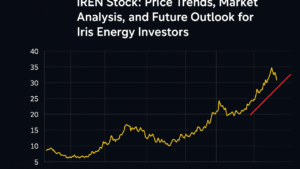
For short-term traders, IREN stock functions primarily as a high-beta play on Bitcoin market momentum. Stock price movements often correlate closely with daily fluctuations in digital asset prices and broader crypto sentiment. Technical swing traders frequently focus on key support and resistance levels around quarterly production announcements, hash rate expansion updates, and Bitcoin halving cycles.
Long-term investors, by contrast, focus on the fundamental value of the firm’s physical infrastructure and AI pivot. Securing large-scale power capacity and building high-performance data centers creates an asset-heavy foundation that outlasts crypto price cycles. Investors with a multi-year outlook view IREN as a secular growth opportunity driven by enterprise demand for NVIDIA GPU computing power.
Key trade-offs between short-term and long-term investment strategies include:
-
Short-Term Catalysts: Bitcoin price surges, monthly mining operational updates, and quarterly earnings beat expectations.
-
Short-Term Risks: High equity volatility, crypto market pullbacks, and broader macroeconomic tech sector sell-offs.
-
Long-Term Catalysts: Multi-year AI cloud hosting contracts, power energization milestones, and steady expansion of annual recurring revenue (ARR).
-
Long-Term Risks: Shareholder dilution from capital raises, hardware obsolescence, and intense competition in the cloud computing space.
Ultimately, market participants must align their position sizing with their personal risk tolerance. While short-term traders must manage volatility with strict stop-loss strategies, long-term investors rely on operational execution metrics and data center asset growth to justify their thesis.
8. Final Verdict: Is IREN Stock a Buy, Sell, or Hold Right Now?
Determining whether IREN is a buy, sell, or hold depends directly on an individual investor’s risk appetite and portfolio goals. The company sits at a unique intersection of high-growth AI compute infrastructure and volatile cryptocurrency operations. Evaluating overall fundamentals alongside real-time Wall Street data provides a grounded final verdict.
For growth-oriented investors, IREN presents a compelling Buy candidate based on its asset-heavy infrastructure moat. The firm’s ability to secure large-scale grid connections and rapidly deploy NVIDIA GPU clusters gives it a distinct advantage over competitors. Financial analysis tracks these key upside drivers:
-
Bull Case (Buy): Expanding high-margin AI hosting contracts, low-cost power agreements, and strong balance sheet liquidity.
-
Base Case (Hold): Steady execution on GPU expansion while managing short-term margin pressures from crypto volatility.
-
Bear Case (Sell): Delays in infrastructure build-outs, heavy equity dilution, or a severe downturn in digital asset prices.
Current Wall Street consensus leans toward a Moderate Buy, with average 12-month analyst price targets indicating significant potential upside. Institutional market coverage remains generally optimistic about management’s operational pivot into enterprise cloud hosting. Readers can cross-check live analyst updates and consensus ratings on market platforms like MarketWatch.
In summary, IREN is best suited for long-term investors looking to gain exposure to AI data center expansion while accepting inherent stock volatility. Conservative investors or dividend seekers may prefer to Hold or look elsewhere until multi-year AI revenues dominate the balance sheet. Proper position sizing and risk management remain essential before taking any market entry.

Frequently Asked Questions (FAQs)
Is IREN stock a good long-term investment?
IREN offers strong long-term growth potential due to its massive grid-connected power capacity and rapid expansion into enterprise AI cloud hosting. However, long-term investors must be comfortable with short-term equity volatility tied to cryptocurrency markets.
What is the price prediction for IREN stock?
Wall Street analysts maintain a wide range of price targets for IREN, with average consensus estimates pointing to notable upside over the next 12 months. Price predictions depend heavily on GPU deployment speed and contracted annual recurring revenue growth.
How does Bitcoin halving affect IREN’s profitability?
Bitcoin halving reduces block rewards by half, which temporarily squeezes mining profit margins across the sector. IREN mitigates this risk by scaling hardware efficiency and diversifying revenue into high-margin AI cloud hosting.
Does Iris Energy (IREN) pay dividends to shareholders?
No, Iris Energy does not currently pay dividends to shareholders. The company reinvests all available cash flow and capital resources into building out data center infrastructure and expanding its GPU fleets.
Conclusion
Iris Energy (IREN) stands out as a high-potential hybrid operator bridging the gap between digital asset mining and modern artificial intelligence infrastructure. While cryptocurrency market swings create ongoing short-term volatility, the firm’s expanding portfolio of renewable-powered data centers provides a durable long-term competitive foundation. Investors seeking high-growth opportunities should weigh analyst price targets against their personal risk tolerance before opening a position.