
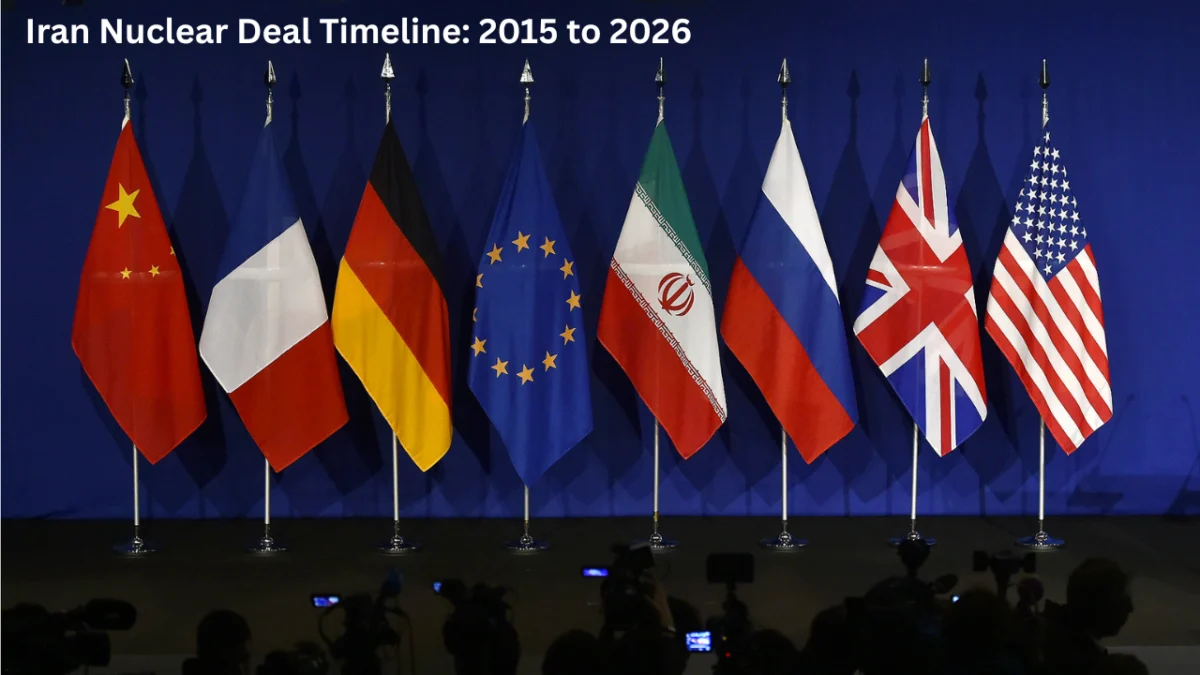
Iran Nuclear Deal Timeline: 2015 to 2026
The Iran Nuclear Deal Timeline: 2015 to 2026 begins with one of the most important diplomatic agreements of the 21st century. The Joint Comprehensive Plan of Action, commonly called the JCPOA, was reached in July 2015 after years of negotiations over Iran’s nuclear program.
The agreement was designed to limit Iran’s nuclear activities and provide international monitoring. In return, Iran was promised relief from nuclear-related sanctions. The deal later faced serious political challenges, especially after the United States withdrew in 2018.
To understand how the agreement eventually unraveled, it is important to start with the events of 2015 and 2016.
Iran Nuclear Deal Timeline: 2015 to 2026: How the JCPOA Began
The JCPOA was not created overnight. It followed years of negotiations between Iran and major world powers.
The European Union played an important coordinating role. France, Germany, and the United Kingdom had also been involved in earlier negotiations with Iran.
July 14, 2015 — The JCPOA Is Agreed
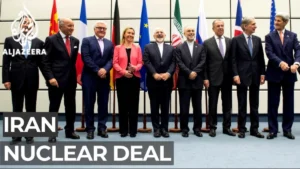
On July 14, 2015, Iran and the E3/EU+3 reached the Joint Comprehensive Plan of Action in Vienna.
The negotiating group included Iran, China, France, Germany, Russia, the United Kingdom, and the United States. The EU High Representative also played a coordinating role. (Consilium)
The agreement aimed to ensure that Iran’s nuclear program remained exclusively peaceful.
In exchange for nuclear restrictions and verification, Iran was set to receive relief from nuclear-related economic and financial sanctions.
This created the basic structure of the deal.
Iran would accept limits.
International inspectors would monitor its nuclear commitments.
The other parties would provide sanctions relief according to the agreed timetable.
July 20, 2015 — The UN Endorses the Agreement
Six days after the agreement was reached, the United Nations Security Council adopted Resolution 2231.
The resolution formally endorsed the JCPOA and established a timetable for its implementation. It also set out the process for lifting certain UN sanctions connected to Iran’s nuclear program. (United Nations)
This step was important because it gave the nuclear agreement a formal place within the UN Security Council framework.
The deal was therefore not simply a bilateral agreement between Iran and the United States.
It involved a wider group of countries and an international implementation process.
July 31, 2015 — The EU Begins Implementation Preparations
The European Union began translating parts of the UN resolution and JCPOA into EU law.
The EU adopted legal measures connected to activities required to prepare for the implementation of the agreement.
This included arrangements concerning certain nuclear-related activities in Iran.
The move showed that the agreement was entering a practical implementation phase rather than remaining only a diplomatic document. (Consilium)
October 18, 2015 — Adoption Day
October 18, 2015, became known as Adoption Day.
Under the JCPOA timetable, the agreement came into effect 90 days after the UN Security Council’s endorsement.
The parties began making the legal and technical preparations needed to carry out their commitments.
What Happened on Adoption Day?
The EU adopted legal acts that prepared the lifting of nuclear-related economic and financial sanctions against Iran.
However, the sanctions relief was not simply immediate.
It was tied to Iran completing agreed nuclear measures and the IAEA verifying those measures.
This distinction was important.
The agreement created a sequence.
Iran had to take specific nuclear steps.
The IAEA had to verify them.
Then the relevant sanctions relief could take effect.
Why Was Adoption Day Important?
Adoption Day transformed the JCPOA from a negotiated agreement into an implementation framework.
It also established a clear timetable for the next major stage.
The focus shifted from diplomacy to verification.
The question was no longer whether the agreement could be reached.
The question was whether all sides would actually carry out their commitments.
November 2015 — Verification Preparations Continue
The International Atomic Energy Agency played a central role in the implementation process.
The IAEA was responsible for monitoring and verifying Iran’s nuclear-related commitments under the agreement.
The agency’s work was important because the JCPOA relied on verification rather than political promises alone.
The IAEA’s Role
The IAEA monitored Iran’s nuclear activities under its safeguards and the arrangements connected to the JCPOA.
In 2015, the agency was authorized to carry out the necessary verification and monitoring of Iran’s nuclear-related commitments.
This helped establish the system that would later be used to determine whether Iran had completed the required steps for Implementation Day. (IAEA)
January 16, 2016 — Implementation Day
One of the most important dates in the entire Iran Nuclear Deal Timeline was January 16, 2016.
This was known as Implementation Day.
On that date, the IAEA confirmed that Iran had implemented the nuclear-related measures required under the JCPOA.
Following that verification, major nuclear-related sanctions were lifted or terminated according to the agreement’s timetable. (Consilium)
What Did Iran Have to Do?
Iran had to take a series of nuclear-related steps before Implementation Day could occur.
These measures were designed to reduce parts of Iran’s nuclear capacity and increase international confidence in the peaceful nature of its program.
The IAEA then verified that the required measures had been carried out.
This verification was a key part of the agreement.
What Sanctions Were Lifted?
The European Union lifted all nuclear-related economic and financial sanctions covered by the JCPOA on Implementation Day.
Some other restrictions remained in force.
These included certain restrictions involving proliferation-sensitive goods, arms, ballistic missiles, and designated individuals or entities. (Consilium)
The change therefore did not mean that every international restriction on Iran disappeared.
It specifically concerned sanctions connected to the nuclear agreement and its implementation.
Why 2016 Was a Major Turning Point
Implementation Day marked the moment when the JCPOA began operating in practice.
Iran had accepted nuclear restrictions.
The IAEA had verified the required steps.
Major nuclear-related EU sanctions were lifted.
For supporters of the agreement, this was evidence that difficult international disputes could be managed through diplomacy and verification.
The Deal Entered a New Phase
After January 2016, the focus moved toward maintaining compliance.
The agreement now depended on continued cooperation between Iran and the other participants.
The IAEA had to continue monitoring Iran’s nuclear activities.
The other parties had to maintain their commitments, including the sanctions-related arrangements established by the agreement.
This created a delicate balance.
The agreement could work only if its participants continued to see value in following it.
2016 — The First Year of Implementation
During 2016, the European Union continued to support the implementation of the JCPOA.
On the first anniversary of the agreement in July 2016, the EU said the deal was being implemented and emphasized the importance of continued compliance and cooperation with the IAEA. (Consilium)
The year therefore represented a period in which the agreement was still functioning as intended.
The major political crisis that would eventually threaten the JCPOA had not yet occurred.
Why the Early Years Matter
The early period is important because it shows that the agreement did not collapse immediately.
It had an operating framework.
It included nuclear restrictions.
It included international verification.
It also provided a mechanism for sanctions relief.
The later breakdown must therefore be understood as a process rather than an instant failure.
Key Takeaway From 2015–2016
The Iran nuclear deal began with a major diplomatic breakthrough in July 2015.
The JCPOA was agreed on July 14.
The UN Security Council endorsed it on July 20 through Resolution 2231.
Adoption Day followed on October 18.
Then, on January 16, 2016, the IAEA verified Iran’s implementation of the required nuclear measures and Implementation Day began.
The EU lifted its nuclear-related economic and financial sanctions as part of the agreed process.
These events created the foundation for the agreement’s next phase.
At this point, the JCPOA was functioning as a negotiated framework supported by international monitoring and sanctions relief.
But the political environment around the agreement would soon become more complicated.
جی، Part 2 میں 2017–2018 cover کرتے ہیں۔ اس حصے میں focus keyword کو ایک relevant H2 میں بھی رکھا ہے، اور H1 صرف Part 1 میں رہے گا تاکہ پورے article میں ایک ہی H1 ہو۔
2017: Growing Pressure Around the Iran Nuclear Deal
By 2017, the JCPOA had moved from negotiation into a more difficult political phase. Iran was continuing to operate under the agreement, while the United States was increasingly questioning whether the deal served its long-term interests.
The agreement itself remained focused on Iran’s nuclear program. But disagreements over missiles, regional security, and U.S.-Iran relations were creating a much wider political conflict.
Trump Takes a Harder Position
Donald Trump became president of the United States in January 2017.
During his presidential campaign, Trump had repeatedly criticized the Iran nuclear agreement. His administration argued that the JCPOA did not address all of the security concerns surrounding Iran.
The new U.S. government therefore began reviewing its approach to the agreement.
Iran’s Compliance Remained a Central Issue
The JCPOA included an extensive monitoring system.
The International Atomic Energy Agency continued to verify Iran’s nuclear commitments. The agency repeatedly reported on Iran’s implementation of its nuclear-related obligations during this period.
At the same time, the Trump administration continued to criticize the agreement’s broader limitations.
This created an important distinction.
The question was not simply whether Iran was following the nuclear restrictions.
It was also whether the United States believed those restrictions were sufficient.
Iran Nuclear Deal Timeline: The Road to the 2018 Withdrawal
The events of 2017 created the political conditions for the major turning point that came the following year.
The United States increasingly argued that the JCPOA was too limited and that Iran’s wider behavior required a different strategy.
October 2017 — Trump Refuses to Certify the Deal
In October 2017, President Trump announced that he would not certify Iran’s compliance with the nuclear agreement under the U.S. domestic certification process.
This decision did not itself withdraw the United States from the JCPOA.
However, it showed that the future of the agreement had become uncertain in Washington.
Trump called for Congress and U.S. allies to address what his administration considered serious weaknesses in the agreement.
What Were the Main U.S. Concerns?
The Trump administration raised several concerns.
These included the duration of some nuclear restrictions, Iran’s ballistic missile activities, and its regional activities.
The administration argued that the agreement should be strengthened.
Iran rejected the idea of renegotiating the JCPOA.
European governments generally wanted to preserve the agreement while also discussing other concerns with Iran separately.
This difference in approach would become increasingly important.
2018: The Major Turning Point
The year 2018 changed the direction of the Iran nuclear deal.
After months of pressure and diplomatic debate, President Trump made the decision to withdraw the United States from the JCPOA.
May 8, 2018 — The United States Withdraws
On May 8, 2018, President Trump announced that the United States would cease participation in the JCPOA and begin reimposing U.S. sanctions that had been lifted or waived as part of the agreement.
This became the most important event in the Iran Nuclear Deal Timeline.
The United States argued that the agreement was not strong enough and that a new approach was necessary.
Washington wanted a broader agreement that would address nuclear issues as well as other concerns.
Why Was the Withdrawal So Important?
The JCPOA involved several countries, but the United States had enormous economic influence.
U.S. sanctions could affect international companies and financial institutions even when those businesses were based outside the United States.
This made the American withdrawal much more consequential than a simple diplomatic disagreement.
The decision also created a direct challenge for the remaining parties.
Europe now had to decide how to preserve the agreement while dealing with renewed U.S. sanctions.
The Maximum Pressure Strategy Begins
After leaving the JCPOA, the Trump administration moved toward a policy known as maximum pressure.
The strategy relied heavily on economic sanctions.
The goal was to put significant pressure on Iran and encourage Tehran to accept a broader agreement.
Sanctions Were Reimposed
The United States began restoring sanctions that had been lifted or waived under the JCPOA.
The process took place in stages during 2018.
Major areas of economic activity were affected, including Iran’s oil exports and access to international financial markets.
The U.S. government argued that these measures were necessary to force Iran to change its behavior.
Iran strongly opposed the policy.
Iran Rejects the U.S. Withdrawal
Iranian leaders condemned the U.S. decision.
Tehran argued that the United States had abandoned an agreement that Iran had been implementing.
Iran also called on the other participants to protect the economic benefits promised under the JCPOA.
This placed Europe in a difficult position.
European governments supported the agreement but had limited ability to shield their companies from the wider effects of U.S. sanctions.
Europe’s Response to the U.S. Withdrawal
France, Germany, and the United Kingdom remained committed to the nuclear agreement.
The European Union also continued to support the JCPOA.
European governments argued that the agreement remained an important tool for limiting Iran’s nuclear activities.
Europe Tries to Keep the Agreement Alive
European governments began exploring ways to preserve legitimate trade with Iran.
They wanted to demonstrate that remaining in the agreement could still provide Iran with economic benefits.
However, this was extremely difficult.
Many European companies had business interests in the United States or depended on the international financial system.
The possibility of facing U.S. penalties made many companies reluctant to continue operating in Iran.
The Blocking Statute
The European Union also updated its Blocking Statute in response to the reimposition of certain U.S. sanctions.
The measure was intended to protect European operators from the effects of specified extraterritorial U.S. sanctions.
However, legal protection alone could not remove all of the commercial risks faced by European businesses.
This highlighted a major weakness in Europe’s ability to independently replace the economic benefits that Iran had expected from the JCPOA.
Why the EU Could Not Easily Replace U.S. Economic Benefits
The European position was politically clear but economically complicated.
European governments wanted to preserve the agreement.
Iran wanted tangible economic benefits.
European companies, however, had to consider the potential consequences of U.S. sanctions.
The Financial System Was a Major Barrier
International trade often depends on banking networks and access to major financial markets.
Because the United States has significant influence over the global financial system, European businesses could not simply ignore American sanctions.
This made trade with Iran much harder.
Even companies that supported the diplomatic agreement could decide that doing business in Iran was too risky.
The result was a growing gap between Europe’s political commitment and the economic benefits it could realistically provide.
November 2018 — Oil Sanctions Return
In November 2018, the United States reimposed sanctions targeting Iran’s oil exports and other economic sectors.
The administration also announced limited exemptions and waivers for certain countries and activities.
The overall objective remained maximum economic pressure on Tehran.
Why Oil Mattered
Oil is one of Iran’s most important sources of export revenue.
Restrictions on oil sales therefore created significant economic pressure.
For Iran, this made the situation very different from the period after Implementation Day in 2016.
The country was once again facing substantial economic restrictions while still being expected to remain within the nuclear agreement.
This tension would become increasingly difficult to sustain.
The Deal Survives, But the Balance Changes
It is important to understand that the U.S. withdrawal did not immediately destroy the JCPOA.
The remaining parties continued to support it.
Iran also did not immediately abandon its commitments.
Instead, the agreement entered a much more fragile period.
Iran Waits for Economic Relief
Iran initially gave European governments time to find ways to preserve the economic benefits of the agreement.
Tehran wanted the other participants to compensate for the loss of U.S. economic participation.
European governments worked on mechanisms intended to support legitimate trade.
But these efforts did not provide an equivalent replacement for the economic access Iran had expected.
The Pressure Continues
As sanctions intensified, the political argument inside Iran also became more difficult.
Supporters of engagement could point to the original agreement.
Critics could argue that Iran had accepted nuclear restrictions but was no longer receiving the economic benefits that had been promised.
This weakened the political foundation of the JCPOA inside Iran.
Why 2018 Changed the Future of the JCPOA
The events of 2018 created several problems at the same time.
The United States was no longer participating.
U.S. sanctions were returning.
Europe wanted to preserve the agreement but struggled to provide equivalent economic benefits.
Iran was increasingly frustrated.
The trust that had supported the original diplomatic compromise was beginning to disappear.
A New Phase Begins
The agreement had entered a completely different stage.
Before 2018, the central question was whether Iran would continue following its nuclear restrictions.
After 2018, another question became just as important:
How long would Iran continue following those restrictions if the economic benefits of the agreement were disappearing?
That question would shape the events of 2019 and beyond.
Key Takeaway From 2017–2018
The Iran Nuclear Deal Timeline changed dramatically between 2017 and 2018.
The Trump administration increasingly criticized the JCPOA and argued that it did not address all of the concerns surrounding Iran.
In October 2017, Trump refused to certify Iran’s compliance under the U.S. domestic process.
On May 8, 2018, he announced the U.S. withdrawal from the agreement.
The United States then began restoring sanctions as part of its maximum-pressure strategy.
European governments tried to preserve the deal, but U.S. economic power made that extremely difficult.
Iran initially remained within the agreement while waiting for Europe to protect its economic interests.
By the end of 2018, however, the conditions that had supported the JCPOA in its early years had changed dramatically.
The next stage would see Iran gradually reduce its compliance with the agreement and tensions rise further.
2019: Iran Begins Reducing Its Nuclear Commitments
The year 2019 marked another major stage in the Iran Nuclear Deal Timeline.
After the United States withdrew from the JCPOA and restored sanctions, Iran initially continued to follow many of its nuclear commitments.
But Tehran increasingly argued that the remaining parties were not providing enough economic benefits.
May 2019 — Iran Announces a New Approach
In May 2019, Iran announced that it would begin reducing some of its commitments under the nuclear agreement.
The move came one year after the U.S. withdrawal.
Iran presented its actions as a response to the economic pressure created by renewed U.S. sanctions.
Tehran also gave the remaining parties opportunities to restore the economic benefits associated with the agreement.
Iran Gradually Exceeds JCPOA Limits
Iran did not abandon every part of the agreement at once.
Instead, it took a step-by-step approach.
Over time, Iran exceeded several limits involving enriched uranium stockpiles, enrichment levels, and other nuclear activities.
This created a growing gap between the nuclear program described in the original JCPOA and the activities Iran was carrying out.
2020: Nuclear Tensions Continue
By 2020, the gap between Iran and the United States had become much wider.
Washington continued its maximum-pressure campaign.
Iran continued expanding activities beyond the original JCPOA limits.
The Dispute Reaches the United Nations
The United States also attempted to use the JCPOA’s dispute and sanctions mechanisms.
However, other parties strongly disagreed with Washington’s interpretation of its position after withdrawing from the agreement.
The issue exposed another weakness in the deal.
The participants no longer agreed on how some of its legal mechanisms should operate after the U.S. withdrawal.
Europe Tries to Preserve Diplomacy
European governments continued to support the JCPOA.
France, Germany, and the United Kingdom remained involved in diplomatic efforts.
But European countries still faced the economic pressure created by U.S. sanctions.
Their ability to maintain trade with Iran remained limited.
The agreement therefore survived politically, but its economic foundation continued to weaken.
2021: Attempts to Restore the Iran Nuclear Deal
The election of Joe Biden created a new opportunity for diplomacy.
The Biden administration supported a return to the JCPOA under negotiated conditions.
Vienna Talks Begin
Negotiations to restore the agreement began in Vienna in 2021.
The discussions involved Iran and the remaining JCPOA participants, with the United States participating indirectly.
The central goal was to find a way for both Washington and Tehran to return to compliance.
Iran wanted sanctions relief.
The United States wanted Iran to reverse its nuclear steps beyond the original limits.
The Problem of Sequencing
One of the hardest issues was deciding who should act first.
Iran argued that the United States should first lift sanctions because Washington had left the agreement.
The United States wanted Iran to return to its nuclear commitments.
This created a difficult diplomatic cycle.
Each side wanted assurances before making major concessions.
2022: Negotiations Face Major Obstacles
Diplomatic efforts continued into 2022.
Negotiators came close to possible understandings at different points, but major disagreements remained.
The Original Deal Became Harder to Restore
The situation was no longer the same as it had been in 2015.
Iran had expanded its nuclear activities.
The United States wanted stronger assurances.
Iran wanted guarantees about future sanctions relief.
The political environment had also changed.
Restoring the original agreement was therefore becoming more difficult with every passing year.
Trust Remained the Central Problem
The 2018 U.S. withdrawal remained a major issue for Tehran.
Iran questioned whether another agreement would survive a future change in U.S. leadership.
Washington, meanwhile, questioned whether Iran would maintain its commitments over the long term.
The trust problem had become one of the biggest barriers to a new agreement.
2023: The Nuclear Dispute Remains Unresolved
By 2023, efforts to revive the JCPOA had not produced a final agreement.
The United States and European countries continued to raise concerns about Iran’s nuclear activities.
Iran continued to insist that its nuclear program was peaceful and that sanctions relief remained central to any diplomatic solution.
The IAEA Faces Monitoring Challenges
International monitoring remained critical.
The IAEA continued its safeguards work in Iran, but the broader monitoring situation had become more difficult than during the original implementation period.
The agency’s ability to provide complete and continuous information became an increasingly important issue in international diplomacy.
The dispute was no longer simply about the original JCPOA text.
It was also about what could still be verified on the ground.
2024: Regional Tensions Add More Pressure
In 2024, the Iran nuclear issue became increasingly connected to wider Middle Eastern tensions.
Relations between Iran, Israel, the United States, and other regional actors became more complicated.
Nuclear Diplomacy Faces a More Difficult Environment
The wider security environment made negotiations harder.
Governments were dealing with regional conflicts and security concerns while also trying to address Iran’s nuclear activities.
This reduced the space for a simple return to the 2015 framework.
The nuclear dispute had become part of a much larger geopolitical confrontation.
2025: The Iran Nuclear Deal Enters a New Phase
The year 2025 became another major turning point.
Diplomatic efforts continued, but the status of the original JCPOA and the UN sanctions framework became increasingly contested.
2025 — Diplomatic Efforts Continue
According to the United Nations, diplomatic efforts intensified during the second half of 2025.
However, the parties did not reach an agreement on a common way forward.
The situation was further complicated by military escalation during June 2025, including strikes on Iranian nuclear facilities.
These developments made an already difficult diplomatic environment even more unstable.
August 2025 — The E3 Moves Toward Snapback
France, Germany, and the United Kingdom, known as the E3, notified the UN Security Council in August 2025 of their intention to trigger the snapback mechanism under Resolution 2231.
The E3 argued that Iran had significantly failed to meet its JCPOA commitments.
Iran rejected that interpretation and argued that the European countries had themselves failed to meet their obligations.
This disagreement became a major legal and diplomatic dispute.
September 2025: UN Sanctions Are Reapplied
September 2025 became one of the most important dates in the later Iran Nuclear Deal Timeline.
The Security Council considered efforts to continue the termination of earlier sanctions.
However, the required resolutions did not receive enough support.
September 27, 2025 — Snapback Takes Effect
Under the UN process, the previously suspended sanctions were re-applied effective September 27, 2025.
The United Nations states that Security Council resolutions 1696, 1737, 1747, 1803, 1835, and 1929 were re-applied through the snapback mechanism.
The move marked a major change in the international sanctions framework surrounding Iran’s nuclear issue.
Not Everyone Accepted the Snapback
The legal status of the process remained contested.
Iran, Russia, and China argued that the E3 did not have a valid basis for triggering the mechanism.
Iran formally rejected the reapplication of the sanctions and disputed the UN Secretariat’s interpretation of the process.
This means the 2025 snapback should be understood as both a major policy development and a source of continuing legal and diplomatic disagreement.
October 2025: The Original UN Timeline Reaches a Critical Date
Resolution 2231 contained a built-in timeline.
Under the original framework, certain provisions were scheduled to expire after ten years, subject to the agreement’s conditions.
The 2025 snapback dramatically changed the practical situation before that timeline could operate as originally expected.
The Dispute Over Resolution 2231
Iran argued that Resolution 2231 should expire according to the original schedule.
Western governments took a different position after the snapback process.
The disagreement showed how deeply divided the international community had become over the status of the original nuclear framework.
2026: Where Does the Iran Nuclear Deal Stand?
By 2026, the original JCPOA is no longer operating in the same form as it did during its implementation period.
The agreement’s original restrictions, verification arrangements, sanctions framework, and political assumptions have all been affected by years of confrontation.
The Original JCPOA Is Difficult to Restore
A simple return to the 2015 arrangement would face major obstacles.
Iran’s nuclear program has changed.
The United States has changed its policy several times.
European governments have struggled to provide meaningful economic incentives.
The UN sanctions framework has also become the subject of major legal and political disputes.
A future agreement would therefore need to address realities that did not exist when the JCPOA was negotiated.
Verification Remains Essential
The IAEA remains central to any future nuclear diplomacy.
Verification is important because governments need reliable information about Iran’s nuclear activities.
Without effective monitoring, disagreements can quickly become claims and counterclaims.
A future agreement would therefore need a credible verification system that all major participants accept.
What the Iran Nuclear Deal Timeline Shows
The timeline shows that the JCPOA did not collapse because of one event.
Its breakdown developed over several years.
The agreement began with a major diplomatic breakthrough in 2015.
Implementation followed in 2016.
Political pressure increased in 2017.
The United States withdrew in 2018.
Iran began reducing its nuclear commitments in 2019.
Attempts to restore the agreement continued from 2021 onward.
By 2025, the dispute had reached another major turning point with the E3’s snapback process and the reapplication of UN sanctions.
By 2026, restoring the original framework had become far more complicated.
The Main Lesson
The most important lesson is that international agreements depend on more than the written text.
They also depend on political trust, economic incentives, verification, and continued cooperation.
The JCPOA had mechanisms for each of these areas.
But once the United States withdrew, the economic balance changed.
Iran’s response then weakened the nuclear restrictions.
European governments could not fully replace the economic benefits that had been lost.
The result was a gradual breakdown rather than an immediate collapse.
Frequently Asked Questions
When was the Iran nuclear deal signed?
The JCPOA was agreed on July 14, 2015, between Iran and the E3/EU+3 countries.
When did the Iran nuclear deal take effect?
Implementation Day occurred on January 16, 2016, after the IAEA verified that Iran had completed the required nuclear measures.
When did the United States leave the Iran nuclear deal?
The United States announced its withdrawal from the JCPOA on May 8, 2018.
When did Iran begin reducing its JCPOA commitments?
Iran began announcing reductions in its commitments in 2019, after the United States had withdrawn and restored sanctions.
What was the snapback mechanism?
The snapback mechanism was a process established by UN Security Council Resolution 2231 that could lead to the reapplication of previous UN sanctions if the specified procedure was triggered.
When were UN sanctions reapplied in 2025?
The United Nations states that the previously suspended sanctions were re-applied effective September 27, 2025, following the snapback process.
Is the Iran nuclear deal still active in 2026?
The original JCPOA is no longer functioning in the same way it did during its implementation period. Its nuclear restrictions and political framework have been heavily undermined by years of non-compliance, sanctions, and diplomatic breakdown.
Conclusion
The Iran Nuclear Deal Timeline: 2015 to 2026 tells the story of a diplomatic agreement that began with optimism but gradually became harder to maintain.
In 2015, Iran and major world powers created the JCPOA to place limits on Iran’s nuclear activities.
In 2016, the agreement entered its implementation phase after IAEA verification.
The political situation changed in 2017.
Then, in 2018, the United States withdrew and restored sanctions.
Iran initially remained within the agreement but began reducing its commitments in 2019.
Diplomatic efforts to revive the deal continued during the Biden administration, but the two sides could not overcome their differences.
By 2025, the dispute had reached a new stage.
The E3 triggered the snapback mechanism, and the United Nations states that previously suspended sanctions were re-applied on September 27.
Iran and other countries disputed the legality and validity of that process.
By 2026, the original JCPOA was therefore far removed from the framework that began in 2015.
The history of the deal shows why nuclear diplomacy is so difficult.
Agreements require restrictions, verification, economic incentives, and political trust to work together.
When those elements weaken, even a carefully negotiated international agreement can become extremely difficult to preserve.
- JCPOA Official Overview — European Council
2015 agreement، Adoption Day، Implementation Day اور U.S. withdrawal کی مکمل timeline کے لیے۔
European Council — Iran’s Nuclear Agreement - JCPOA Timeline — European Council
2015 سے 2025 تک major dates کے لیے سب سے useful source ہے۔
EU — JCPOA Nuclear Proliferation Timeline - UN Security Council Resolution 2231
Resolution 2231، UN framework اور sanctions timeline کے لیے۔
UN Security Council — Resolution 2231 - IAEA — JCPOA Verification & Monitoring
Iran کی nuclear commitments کی verification اور IAEA monitoring explain کرنے کے لیے۔
IAEA — JCPOA Verification and Monitoring - EU Statement on JCPOA — 2017
2017 میں EU کا موقف اور IAEA verification کے حوالے سے useful primary source۔
EU — Statement on the Iran Nuclear Deal - IAEA — Iran Verification Report, 2019
2019 میں Iran کی JCPOA implementation اور monitoring کے لیے۔
IAEA — Iran Verification and Monitoring Report - EU — 2025 Sanctions Timeline
2025 کے snapback اور September 29, 2025 کو EU sanctions کے reimposition کے لیے۔
EU — 2025 Iran Sanctions Snapback - EU — Current Iran Sanctions
2025 کے بعد کی sanctions position اور current context کے لیے۔
EU — Current Sanctions Against Iran

[…] helps us understand how world powers make big decisions, much like studying the detailed Iran Nuclear Deal Timeline to see how multi-nation talks unfold over long […]