

Table of Contents
ToggleMojo Box Office Movies: How to Find Movie Box Office Data
If you are searching for mojo box office movies, you are most likely looking for Box Office Mojo, a popular source for movie box-office information. The site tracks theatrical performance and provides data such as daily grosses, weekend results, release schedules, domestic earnings, international totals, and movie rankings.
For movie fans, this information can answer simple questions such as which film is currently leading the box office, how much a movie has earned, and how a new release is performing against other films.
For people who follow the film business more closely, the data can also help show whether a movie is becoming a commercial success or struggling at the box office.
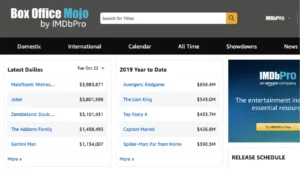
What Is Box Office Mojo?
Box Office Mojo is a movie box-office tracking service that provides financial performance data for theatrical releases. Its database covers individual movies as well as broader box-office charts and release information.
The platform is particularly useful because box-office performance changes every day. A movie that finishes first on Friday may not remain at number one by Sunday. Weekend totals can also look very different from weekday results.
Box Office Mojo therefore provides several ways to examine movie performance instead of relying on a single number.
Academic researchers also use Box Office Mojo data when studying the movie industry. Research published in the Review of Finance, for example, describes using Box Office Mojo for daily U.S. box-office data and movie-level information.
What Can You Find on Box Office Mojo?
The main value of Box Office Mojo is the amount of box-office information available for individual movies and release periods.
Depending on the movie and chart, users can find information such as:
- Daily box-office grosses
- Weekend grosses
- Domestic box-office totals
- International earnings
- Worldwide grosses
- Release dates
- Number of theaters
- Opening-weekend performance
- Historical rankings
The site also provides release schedules, allowing users to see upcoming theatrical releases and changes to planned release dates. Its current schedule includes wide releases, limited releases and re-releases.
How to Search for Movies on Box Office Mojo
Finding a particular movie is usually straightforward.
Start by searching for the movie title and then open its box-office page. The movie page can provide a more detailed picture of its theatrical performance than a simple search result.
For example, someone researching a newly released blockbuster may want to compare its opening weekend with its later weekday performance.
A movie’s total gross alone does not tell the entire story.
A film that has been in theaters for three months naturally has more time to accumulate revenue than a movie released only a few days ago. Looking at opening weekend, daily performance and release duration gives more useful context.
Mojo Box Office Movies and Current Rankings
One of the most useful features for casual movie fans is the ability to see which films are performing strongly at a particular time.
Current Box Office Mojo data, for example, lists Toy Story 5, The Super Mario Galaxy Movie, Michael, Project Hail Mary, and The Odyssey among the leading 2026 domestic performers on its current chart.
These rankings can change as more movies are released and existing films continue their theatrical runs.
That makes box-office charts more useful when viewed with the date attached. A ranking is a snapshot of performance at a particular point in time, not a permanent measurement.
Why Box Office Numbers Matter
Movie earnings are more than just entertainment statistics.
Studios, investors, distributors and industry analysts use box-office performance to evaluate the commercial results of theatrical releases. A strong opening can indicate significant audience interest, while a weak opening can create pressure for a movie to perform better in subsequent weeks.
However, box-office revenue should not be confused with profit.
A movie can generate hundreds of millions of dollars and still face substantial costs from production, marketing, distribution and theater arrangements. Therefore, a movie’s gross revenue alone cannot establish how profitable it ultimately becomes.
This distinction is important when reading box-office reports.
What We Will Cover Next
In the next part, we will look at how to read Box Office Mojo movie numbers, including domestic vs. worldwide gross, opening weekend figures, daily grosses, rankings and what those numbers actually tell you about a movie’s performance.
How to Read Box Office Mojo Movie Numbers
If you are researching mojo box office movies, the numbers can look confusing at first. Box Office Mojo separates movie earnings into different categories, including domestic, international and worldwide totals. It also provides daily, weekend and weekly charts. (Box Office Mojo)
Understanding these figures is important because a movie’s total earnings tell only part of its theatrical story.
Domestic Box Office
The domestic figure generally refers to theatrical revenue from the United States, Canada and Puerto Rico. Box Office Mojo provides separate daily, weekend, weekly, monthly and yearly domestic charts. (IMDb Help)
For example, a movie might earn $100 million domestically during its theatrical run. That number tells you how much revenue it generated in the domestic market, but it does not include money earned internationally.
Domestic performance is often closely followed because the U.S. and Canadian market remains an important part of the global movie business.
International Box Office
International box office refers to markets outside the domestic region. Box Office Mojo provides weekend results for international territories where it receives reporting data. (IMDb Help)
A movie can perform differently from one country to another.
A Hollywood film might have a moderate domestic opening but become a major success internationally. Another movie could perform extremely well in North America while attracting a smaller overseas audience.
That is why looking at only one market can give an incomplete picture.
Worldwide Box Office
The worldwide gross combines domestic and international theatrical revenue.
This is often the number people use when discussing the biggest box-office successes.
For example, Box Office Mojo currently lists Disclosure Day with separate domestic and international grosses alongside a worldwide total, showing how the individual markets contribute to the film’s overall theatrical performance. (Box Office Mojo)
However, worldwide gross should not automatically be interpreted as profit.
A movie’s revenue has to be considered alongside production costs, marketing expenses and the distribution arrangements involved in releasing the film.

What Is an Opening Weekend?
The opening weekend is one of the most closely watched numbers in the movie industry.
It measures how much a film earns during its initial weekend of release. A strong opening can indicate that a movie has significant audience interest before word of mouth has had much time to develop.
Box Office Mojo records weekend performance with information such as rank, gross, percentage change, number of theaters and cumulative earnings. (Box Office Mojo)
A movie’s opening weekend should not be confused with its final box-office total.
A film can open strongly and then experience a large decline in its second weekend. Another movie might have a modest opening but remain in theaters for many weeks and build a much larger total.
Why Daily Box Office Numbers Matter
Daily figures provide a more detailed view of a movie’s performance.
They can show how a film performs on weekdays compared with Friday, Saturday and Sunday. This can help analysts understand whether audience demand is holding up after the initial release.
Box Office Mojo provides domestic daily charts and allows users to examine results by individual dates and periods. (IMDb Help)
This information becomes especially useful when comparing two movies that have similar opening weekends but follow different patterns afterward.
One may continue attracting audiences steadily, while another may experience a sharp decline.
What Does a Movie’s Rank Mean?
A box-office rank tells you how a movie performed compared with other films during a particular period.
A movie ranked No. 1 for a weekend generated the highest reported weekend gross among the films included in that chart.
But ranking does not necessarily tell you which movie is the most successful overall.
A film can rank first during one weekend and eventually earn less worldwide than a movie that spent several weeks near the top.
The date and chart being examined therefore matter just as much as the ranking itself.
Why Theaters Matter in Box Office Data
The number of theaters showing a movie can also help explain its earnings.
A blockbuster playing in thousands of theaters has a much larger opportunity to generate revenue than a limited-release movie playing in only a few hundred locations.
Box Office Mojo’s movie performance tables can show theater counts alongside grosses and average earnings. (Box Office Mojo)
This gives readers additional context when comparing films with very different release strategies.
A limited-release movie with a high per-theater average may be performing impressively even if its total gross is much smaller than a major studio blockbuster.
The Key Numbers to Watch
For a quick understanding of a movie’s theatrical performance, focus on:
Opening weekend — Shows the initial audience response.
Domestic gross — Measures revenue from the domestic market.
International gross — Shows performance outside the domestic market.
Worldwide gross — Combines domestic and international theatrical revenue.
Weekend change — Shows whether earnings are rising or falling compared with the previous weekend.
Theater count — Provides context for how widely the movie was released.
Looking at these numbers together gives a much clearer picture than focusing on one headline figure.
How to Use Box Office Mojo for Movie Research
For anyone searching for mojo box office movies, Box Office Mojo can be useful not only for checking a single film but also for comparing movies, following box-office trends and researching historical performance. The platform provides domestic, international and worldwide charts, along with daily, weekend, weekly, monthly and yearly data. (Box Office Mojo)
Comparing Movies With Box Office Mojo
One of the easiest ways to use the platform is to compare two or more films.
You can compare their opening weekends, domestic totals, international earnings and worldwide grosses. This can help answer questions such as whether one blockbuster performed better than another or whether a movie’s success came mainly from North America or overseas markets.
For example, the current 2026 worldwide chart shows significant differences in how major releases have performed across domestic and foreign markets. Toy Story 5, Michael, and The Super Mario Galaxy Movie are among the year’s leading worldwide releases, but each has a different domestic-to-international earnings mix. (Box Office Mojo)
That makes the raw worldwide total more useful when you also examine where the money came from.
Historical Movie Rankings
Box Office Mojo also allows users to explore all-time box-office charts.
This is useful when someone wants to know how a movie compares with the biggest theatrical successes in history. The worldwide lifetime chart currently places Avatar, Avengers: Endgame, and Avatar: The Way of Water among the highest-grossing films, based on worldwide lifetime grosses. (Box Office Mojo)
Historical rankings can also reveal something that current weekly charts cannot: longevity.
A movie may dominate for several weeks but still fall far below the biggest lifetime earners. Another film may build a huge total over a long theatrical run.
Box Office Success Does Not Mean Profit
This is one of the most important points to remember when researching movie earnings.
A film’s box-office gross represents theatrical revenue. It does not automatically represent the amount of money the studio earned as profit.
Studios and distributors have production, marketing and distribution expenses, while theaters also receive a portion of ticket revenue.
Therefore, saying that a movie earned $500 million does not mean the studio made $500 million in profit.
Box Office Mojo is excellent for tracking gross box-office performance, but profitability requires additional financial information.
Why Box Office Mojo Data Can Change
Box-office figures are reported over time and can be updated as additional information becomes available.
Box Office Mojo says its data comes from multiple sources, including studios, distributors, sales agents and other sources around the world. (IMDb Help)
This is another reason to include a date when publishing current box-office figures.
For example, an article stating that a movie has earned $300 million could become outdated as soon as the film earns additional revenue over the following weekend.
For NexaVice, current box-office articles should therefore be reviewed and updated when major figures change.

How to Get the Most From Box Office Mojo
The best approach is to use several data points together rather than relying on a single ranking.
Start with the movie’s opening weekend to understand its initial audience response. Then check its subsequent weekend performance to see whether interest is holding up.
Next, examine domestic and international totals.
Finally, look at the worldwide figure to understand the movie’s overall theatrical reach.
This approach creates a much clearer picture than simply saying a movie is “No. 1 at the box office.”
Is Box Office Mojo Useful for Movie Fans?
Yes. Casual viewers can use it to check how much a movie has earned, while journalists, researchers and entertainment professionals can use its broader collection of charts and historical information.
IMDb describes Box Office Mojo as a resource for entertainment professionals, journalists, researchers, financiers and movie fans. It tracks box-office information across more than 60 countries and territories. (IMDb Help)
For NexaVice readers, its biggest value is simple: it turns movie popularity into measurable box-office data.
Final Thoughts
Mojo box office movies searches are closely connected with Box Office Mojo, a useful source for tracking theatrical movie performance.
Whether you want to find the latest rankings, compare two films, examine worldwide grosses or explore all-time records, the platform provides multiple ways to research movie earnings. Its domestic, international and worldwide charts make it possible to understand not just how much a movie earned, but also where that revenue came from. (Box Office Mojo)
The most important thing is to read the numbers in context. A high worldwide gross does not automatically mean high profit, and a No. 1 weekend ranking does not necessarily make a film one of the biggest movies in history.
Used correctly, Box Office Mojo gives movie fans a clearer view of the business behind the films they watch.
FAQs
What is Box Office Mojo used for?
Box Office Mojo is used to track movie box-office performance, including domestic, international and worldwide grosses, rankings and release information. (IMDb Help)
Can I compare different movies on Box Office Mojo?
Yes. Its charts and data allow users to compare films across different periods and markets.
What does worldwide box office mean?
Worldwide box office combines a movie’s domestic and international theatrical grosses.
Is Box Office Mojo accurate?
Box Office Mojo gathers data from studios, distributors, sales agents and other sources. Figures can also be updated as additional reporting becomes available. (IMDb Help)
Does a high box-office gross mean a movie was profitable?
No. Gross revenue and profit are different measurements. Production, marketing and distribution costs must also be considered.



[…] explore more about commercial metrics and earnings milestones by checking out detailed insights on Mojo Box Office Movies. At its core, a fantastic animals movie represents a unique blend of high-concept fantasy and […]