Understanding the Boötes Void Size
When astronomers first mapped the distribution of galaxies across the universe, they expected to find a uniform spread of matter. Instead, they discovered colossal regions of space containing very few galaxies, known as cosmic voids. The most famous of these empty zones is the Boötes Void, which stands out because of its extreme dimensions and mysterious origin. Understanding the bootes void size helps researchers test theories about how gravity and dark energy shape the cosmos on a grand scale. By studying this enormous hole in space, scientists gain valuable clues about the large-scale structure of the universe.
Deep space is rarely completely empty, but some regions contain far less material than others. For example, standard cosmic filaments weave between massive empty bubbles, creating a structure that resembles a giant sponge. The Boötes Void represents an extreme version of these bubbles, spanning a distance that challenges human imagination. While normal space teems with thousands of galaxies in a given volume, this region holds only a tiny fraction of that expected number. Researchers often use this unique territory to learn more about broader science discoveries involving cosmic evolution.
Measuring something as vast as a cosmic void requires specialized tools and deep sky surveys. Astronomers look at the redshift of light from distant galaxies to map their positions in three dimensions. Through this mapping, they can outline the boundaries where normal galaxy clusters begin and end. Such surveys take decades of observation and require advanced telescopes to capture faint signals from billions of light-years away. Every new telescope generation improves our ability to define the edges of these distant structures.
The sheer scale of the void often leaves people wondering how nature could create such a massive deficit of matter. Gravity usually pulls matter together to form stars, planets, and galaxies over billions of years. In a void, however, something must have prevented normal matter from gathering in expected amounts. Theorists suggest that smaller voids may have merged over cosmic time to clear out this immense patch of space. As the universe expanded, these empty regions grew even larger, pushing surrounding galaxies further apart.
Exploring this topic also connects to how we view our place in the wider cosmos. Earth sits safely inside the Milky Way galaxy, which belongs to a relatively crowded local group of galaxies. Looking out toward distant voids reminds us of the extreme diversity found in the night sky. While some areas crowd together in dense clusters, others stretch across incomprehensible distances of emptiness. This contrast drives modern astrophysics forward and keeps researchers asking fundamental questions about reality.

What is the True Boötes Void Size?
Exploring the Diameter of the Void
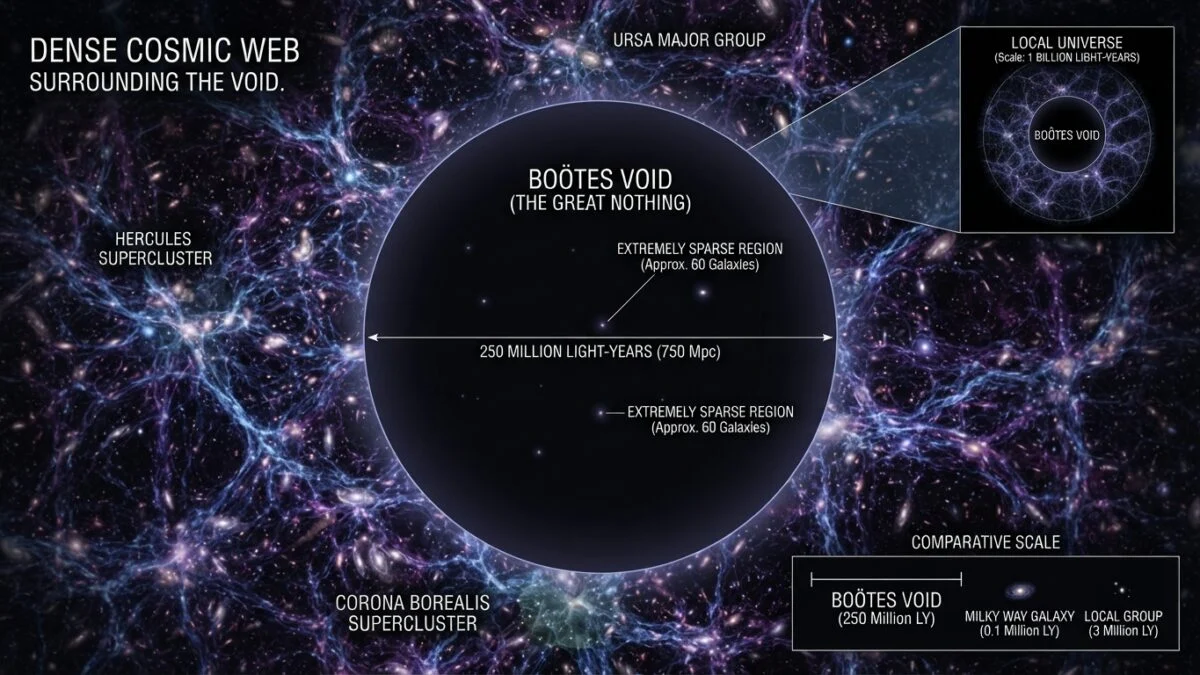
The bootes void size is often measured by its immense diameter across space. Most estimates place its width at roughly three hundred million light-years across. To put that into perspective, light takes three hundred million years just to travel from one side of the void to the other. Still, some newer observations suggest the region might be even larger depending on how astronomers define its outer edges. This staggering width makes it one of the largest single structures found anywhere in the observable universe.
Comparing the Void to Our Local Cosmic Neighborhood
Human brains struggle to visualize distances on a cosmic scale without helpful comparisons. For instance, if you placed the Milky Way galaxy inside the Boötes Void, it would take millions of years of travel just to reach another galaxy. In our actual local neighborhood, galaxies sit much closer together and interact with one another through gravity. However, inside this void, a hypothetical astronaut could look out into the dark for millions of light-years without seeing a single bright galaxy. This extreme isolation makes the region a fascinating case study for galactic evolution.
Calculating the Total Volume in Cubic Light-Years
Calculating the volume of a nearly spherical region this large yields numbers that defy everyday comprehension. The total volume spans hundreds of thousands of cubic light-years of space. Because the math involves such vast numbers, scientists rely on supercomputers to model the expansion and density of the region. These calculations help confirm whether the emptiness matches standard models of cosmic inflation and gravity. You can read more about how scientists map these vast distances by checking out general science discoveries that cover modern astronomy.
Understanding the Matter Density Inside
Even though the region is called a void, it is not a complete vacuum devoid of all matter. Astronomers have detected a small handful of galaxies scattered deep within the interior of the bubble. These isolated galaxies often show unusual properties because they grew up far away from the gravitational influence of neighboring groups. Finding them helps researchers understand how galaxies can survive and evolve in such lonely environments. Each lonely island of stars acts as a natural laboratory for studying quiet cosmic growth.
How Astronomers Discovered the Great Emptiness
Finding the Void Through Early Redshift Surveys
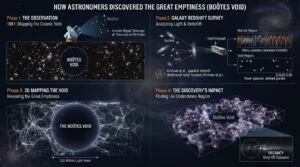
The discovery of the Boötes Void happened during galaxy redshift surveys conducted in the late twentieth century. Astronomers aimed their telescopes at the northern sky in the direction of the constellation Boötes to measure how fast galaxies moved away from Earth. They noticed an unexpected gap where their instruments stopped detecting the usual background hum of galaxy clusters. This sudden drop in galaxy counts signaled the presence of an enormous empty bubble. Researchers realized they had stumbled upon something truly unique in the sky.
Mapping the Surrounding Galaxy Walls
Mapping the interior required outlining the thick walls of matter that surround the empty space. These surrounding walls contain thousands of normal galaxies packed tightly together in clusters and filaments. By plotting the positions of these boundary galaxies, researchers could draw a rough 3D shape of the interior. The contrast between the dense walls and the empty core proved that the void was a real physical structure rather than a trick of perspective. You can learn more about how space agencies protect and study our cosmic environment by exploring planetary defense and cosmic research.
Refining Measurements With Modern Telescopes
Early measurements carried high margins of error because telescope technology had strict limits. Modern ground-based instruments and space telescopes have since refined our understanding of the region. They collect sharper data that separates foreground stars from distant background galaxies with high precision. As a result, astronomers now have a much clearer picture of the boundaries and internal contents of the void. This technological progress ensures our maps of the universe become more accurate every decade.
The Role of Computer Simulations
Computers play a vital role in testing whether our theories match the actual size of the void. Scientists input the laws of gravity and dark energy into massive simulation programs to watch virtual universes grow from the Big Bang. These simulations frequently produce large empty bubbles that look remarkably like the Boötes Void. Seeing the void form naturally in a computer model gives scientists confidence that our basic understanding of cosmology is correct. Still, rare anomalies continue to push theorists to refine their models.
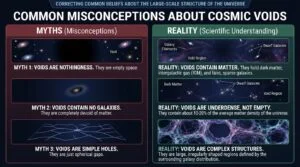
Common Misconceptions About Cosmic Voids
Why Voids Are Not Complete Vacuums
Many people assume a cosmic void is a region where absolutely nothing exists. In reality, every cubic inch of space contains background radiation, stray gas atoms, and dark matter. The Boötes Void simply contains far fewer bright galaxies than average regions of the universe. Calling it a void is a convenient label for a place with low density rather than absolute emptiness. Physics does not allow for a truly empty pocket because quantum fluctuations and gravity always leave some trace of matter behind.
The Myth That Light Cannot Travel Through Voids
Another common misunderstanding involves how light behaves when passing through these empty regions. Some assume that light gets trapped or destroyed inside a void, but photons travel through them just fine. In fact, light from background galaxies passes straight through the Boötes Void to reach our telescopes on Earth. Astronomers actually use this background light to study the foreground matter through gravitational lensing and other optical effects. The darkness of the void simply comes from a lack of luminous stars, not a block on light itself.
Misjudging the Shape of the Emptiness
People often picture cosmic voids as perfect spheres floating in the dark. However, gravitational forces and cosmic expansion distort these bubbles into irregular, complex shapes. The Boötes Void likely resembles a lumpy, stretched balloon rather than a neat geometric sphere. Neighboring galaxy clusters pull on its edges from various directions, warping its boundaries over long spans of time. Recognizing this irregular shape is crucial when calculating the true volume of the region.
Overestimating the Mystery of Its Origin
While the void is exceptionally large, its existence does not break the laws of physics. Some sensational stories treat the region as an unnatural hole punched into reality by unknown forces. Instead, standard cosmological models explain large voids as natural outcomes of gravitational instability. Small initial density fluctuations in the early universe simply grew larger over billions of years of expansion. Science treats the region as a grand scale test rather than an inexplicable mystery.
Frequently Asked Questions
What is the size of the Boötes Void?
The Boötes Void measures approximately three hundred million light-years in diameter, making it one of the largest known empty regions in the universe.
Are there any galaxies inside the Boötes Void?
Yes, the void contains a small number of isolated galaxies, though its density is far lower than typical regions of the cosmos.
How was the Boötes Void discovered?
Astronomers discovered it during redshift surveys in the late twentieth century while mapping the distribution of distant galaxies in the northern sky.
Could humans ever travel across the Boötes Void?
Traveling across the void would take millions of years with current technology because the distance between galaxies inside and around it is so vast.
Conclusion
The Boötes Void remains a testament to the grand scale and complexity of our universe. Measuring three hundred million light-years across, this massive region challenges our understanding of how matter distributes itself over cosmic time. While many details about its precise formation and internal contents require further research, astronomers continue to map its borders with growing precision. Future space missions and deeper sky surveys will undoubtedly reveal even more secrets hidden within the darkest corners of the cosmos. To learn more about ongoing space missions and unexpected events in our solar system, read about how a spacecraft impact occurred on the lunar surface or check updates on orbital management and satellite deorbits.