
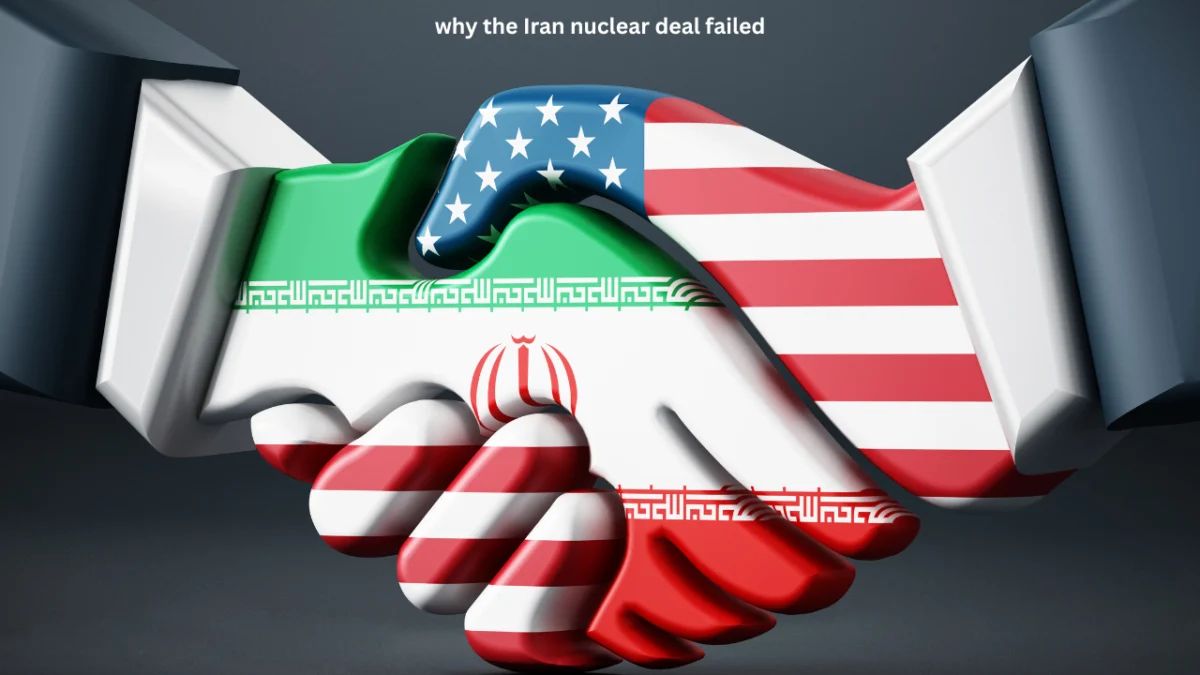
Why the Iran Nuclear Deal Failed: Key Reasons Explained
The question of why the Iran nuclear deal failed remains important in global politics. The 2015 agreement was designed to limit Iran’s nuclear activities in exchange for sanctions relief. For several years, it created a framework for inspections, restrictions, and international diplomacy. But the agreement eventually broke down after the United States withdrew from it and Iran gradually stopped following many of its limits.
The story is more complicated than one country simply ending the deal. The agreement faced political pressure, disagreements over its long-term limits, concerns about regional security, and a growing lack of trust between Iran and the United States.
To understand its collapse, it is first necessary to understand what the deal was supposed to achieve.
Why the Iran Nuclear Deal Failed: Understanding the Early Weaknesses
The Iran nuclear deal was created to reduce tensions, but it also contained political and structural weaknesses that became clearer over time.
The agreement depended on several conditions working together. Iran had to follow its nuclear restrictions, international inspectors had to verify compliance, and the other parties had to maintain the economic benefits promised under the deal.
The Deal Depended on Political Trust
Trust was one of the most important parts of the agreement.
Iran accepted significant restrictions on its nuclear activities because it expected sanctions relief and continued international engagement.
The United States and its allies, meanwhile, expected Iran to maintain its commitments and accept international monitoring.
This arrangement worked only as long as the major participants remained committed to it.
Economic Benefits Were Also Important
Sanctions relief was a central part of the agreement.
Iran expected greater access to international trade, investment, and financial opportunities in return for accepting limits on its nuclear program.
If those economic benefits disappeared, the political incentive for Iran to maintain the restrictions could become much weaker.
This weakness would become especially important after the United States later withdrew from the agreement.
The Agreement Did Not Resolve Every Dispute
Another limitation was the narrow scope of the JCPOA.
The agreement focused mainly on Iran’s nuclear activities. It did not resolve every disagreement between Iran and Western governments.
Issues involving Iran’s missile program, regional influence, and broader U.S.-Iran relations remained outside the central framework.
These unresolved disputes continued to create political pressure around the nuclear agreement.
Why These Weaknesses Mattered Later
At the beginning, these problems did not necessarily make the agreement impossible to maintain.
However, they made the JCPOA more vulnerable to major political changes.
When the United States later changed its policy toward Iran, the agreement faced a serious test.
The economic incentives weakened, trust declined, and the parties increasingly disagreed about what should happen next.
Understanding these early weaknesses helps explain why the Iran nuclear deal failed rather than treating its collapse as the result of a single decision.
Why Did Iran Agree to the Deal?
Iran had strong economic reasons to negotiate.
Years of sanctions had placed pressure on the Iranian economy. Restrictions on oil exports, banking, investment, and international trade had created significant economic challenges.
Sanctions Relief Was a Major Incentive
The agreement offered Iran a path toward economic relief.
Iran could regain greater access to international trade and financial markets. Its oil exports could also benefit from the reduction of nuclear-related sanctions.
For Tehran, the deal represented a compromise.
Iran accepted limits on parts of its nuclear program in exchange for economic benefits and recognition of its right to pursue peaceful nuclear activities under international rules.
Iran Wanted Recognition of Its Nuclear Rights
Iran also wanted the agreement to recognize its right to peaceful nuclear technology.
This was politically important inside Iran. The nuclear program had become connected to national sovereignty and technological independence.
Any agreement therefore had to balance international concerns with Iran’s demand for peaceful nuclear rights.
Why Did the United States Support the Deal?
The Obama administration viewed diplomacy as the best way to prevent Iran from moving closer to a nuclear weapons capability.
The United States had other options, including maintaining sanctions or increasing military pressure. But Washington argued that a negotiated agreement could place verifiable limits on Iran’s nuclear activities without starting another major conflict in the Middle East.
The Deal Focused on Verification
A major strength of the JCPOA was its verification system.
Instead of relying only on promises, the agreement established monitoring arrangements involving the IAEA.
The logic was straightforward.
If Iran followed the restrictions and inspectors could verify compliance, the international community would have greater confidence that its nuclear program was being limited according to the agreement.
This verification system became one of the most important parts of the JCPOA.
The Role of the European Union
The European Union was an important part of the diplomatic process.
The EU helped bring the negotiating countries together and played a central role in maintaining communication between Iran and the Western powers.
Europe Supported the Diplomatic Approach
European governments generally viewed the JCPOA as an important tool for reducing nuclear tensions.
The United Kingdom, France, and Germany were directly involved in the negotiations. These three countries were known as the E3.
Their governments supported the agreement and later opposed the U.S. decision to withdraw from it.
For Europe, preserving the nuclear agreement was not only about relations with Iran. It was also about preventing another major security crisis in the Middle East.
Europe Faced a Difficult Position
The European countries wanted Iran to continue following the agreement.
At the same time, they had to deal with renewed U.S. sanctions after Washington left the JCPOA in 2018.
This created a major problem.
European companies and financial institutions could face consequences for doing business with Iran because of U.S. sanctions. Many businesses were therefore reluctant to return to the Iranian market even though the European governments still supported the nuclear agreement.
This gap between European diplomatic support and the economic reality of U.S. sanctions became increasingly important.
Did the Iran Nuclear Deal Work at First?
For a period, the agreement significantly changed the nuclear dispute.
Iran accepted restrictions on important parts of its nuclear program. International inspectors also monitored Iranian facilities under the agreement.
The JCPOA did not solve every disagreement between Iran and the West. It was specifically focused on the nuclear issue.
That distinction matters.
Iran’s regional activities, missile program, relations with neighboring countries, and broader confrontation with the United States remained separate sources of tension.
The Deal Had Limits From the Beginning
The agreement was never designed to resolve every dispute between Iran and the international community.
Its main purpose was to address Iran’s nuclear activities.
This limitation later became one of the biggest political arguments surrounding the deal.
Critics argued that the agreement did not permanently address every concern about Iran’s nuclear program. Supporters argued that a verifiable agreement was better than having no restrictions at all.
This disagreement would become increasingly important after the change in U.S. policy.
The Political Divide Over the JCPOA
The deal had supporters and critics from the beginning.
Supporters argued that the agreement reduced nuclear risks and created a system for international verification.
Critics argued that some restrictions were temporary and that the agreement did not sufficiently address Iran’s missile program or regional activities.
These competing views existed not only between countries but also within domestic politics in the United States and Iran.
Different Views of the Same Agreement
For supporters, the JCPOA was a diplomatic achievement.
For critics, it was an incomplete agreement that postponed some difficult problems.
This difference in interpretation became critical when the U.S. administration changed.
The future of the agreement increasingly depended on whether the next American administration would continue supporting it.
What Changed After 2016?
The political environment surrounding the agreement began to change.
The election of Donald Trump as U.S. president created uncertainty about the future of the JCPOA.
Trump had strongly criticized the agreement during his campaign and argued that it did not go far enough in restricting Iran.
His administration eventually adopted a much harder approach toward Tehran.
The disagreement was no longer only about how Iran was implementing the agreement. It became a broader question about whether the agreement itself was strong enough to protect U.S. and regional security interests.
This dispute eventually led to the most important turning point in the history of the JCPOA: the U.S. withdrawal in 2018.
That decision would fundamentally change the future of the agreement.
Why Did the Iran Nuclear Deal Fail?
The biggest turning point came in 2018, when the United States withdrew from the Joint Comprehensive Plan of Action. The decision changed the balance that had kept the agreement working.
Before the withdrawal, the main dispute was about how well the agreement could control Iran’s nuclear activities. After the withdrawal, the dispute became much broader.
The United States wanted a stronger agreement. Iran wanted the existing agreement and its economic benefits to be preserved.
That difference proved extremely difficult to overcome.
The U.S. Withdrawal From the JCPOA
In May 2018, President Donald Trump announced that the United States would leave the nuclear agreement.
The administration argued that the JCPOA did not permanently prevent Iran from developing nuclear capabilities. It also criticized the agreement for not covering Iran’s ballistic missile program and regional activities.
Why Did Trump Oppose the Deal?
Trump had criticized the agreement before becoming president.
His administration argued that some nuclear restrictions were temporary and that the deal did not address several other security concerns involving Iran.
The administration also believed that stronger economic pressure could force Tehran to accept a broader agreement.
This approach became known as the maximum pressure campaign.
What Happened After the Withdrawal?
The United States restored sanctions that had been lifted or suspended under the nuclear agreement.
Washington also introduced additional sanctions against Iran.
The goal was to reduce Iran’s access to international finance and limit its ability to earn revenue from oil exports.
The strategy was based on a simple idea: severe economic pressure could push Iran back to the negotiating table.
However, the immediate result was not a new agreement.
Instead, tensions between Washington and Tehran increased.
The Maximum Pressure Campaign
The maximum pressure strategy became one of the defining developments after the U.S. withdrawal.
The United States sought to make the economic cost of Iran’s policies much higher.
Economic Pressure on Iran
Sanctions affected major parts of Iran’s economy.
Oil exports were especially important because petroleum revenue is a major source of income for Iran.
The U.S. campaign also targeted financial institutions, businesses, individuals, and organizations connected to the Iranian government and economy.
The pressure weakened Iran’s economic position.
But economic pressure did not automatically produce the political result Washington wanted.
Iran Rejected the U.S. Approach
Iran argued that the United States had violated the agreement by leaving it despite Iran’s compliance with its commitments at the time.
From Tehran’s perspective, there was little reason to accept new restrictions if the economic benefits of the original agreement could no longer be guaranteed.
Iran therefore resisted the maximum-pressure strategy.
The disagreement became a cycle.
Washington increased pressure.
Tehran increased resistance.
As the confrontation continued, diplomatic trust became harder to rebuild.
Iran’s Response to the U.S. Withdrawal
Iran did not immediately abandon the nuclear agreement.
This is an important part of the story.
For some time, Tehran continued to follow many of its commitments while European governments tried to preserve the deal.
But Iran repeatedly argued that the remaining parties needed to deliver the economic benefits promised under the agreement.
When those benefits failed to materialize, Iran gradually began reducing its compliance.
Iran Began Exceeding Nuclear Limits
From 2019 onward, Iran gradually exceeded several of the limits established by the JCPOA.
These steps included changes involving enriched uranium stockpiles, enrichment levels, and other nuclear activities.
Iran generally presented these actions as a response to the U.S. withdrawal and the failure to receive expected economic benefits.
The United States viewed the developments very differently.
Washington argued that Iran was violating the agreement and moving closer to the ability to produce weapons-grade material.
The dispute therefore became increasingly difficult to separate from the broader political conflict.
Why Did Iran Not Leave Immediately?
Iran had a strategic reason to move gradually.
Leaving the agreement completely could have removed another important diplomatic channel.
By taking step-by-step measures, Tehran could argue that its actions were a response to the loss of economic benefits rather than an immediate rejection of diplomacy.
This approach also kept pressure on European governments to find a way around U.S. sanctions.
But over time, the gap between Iran and the remaining parties became wider.
Why Could Europe Not Save the Deal?
The European Union, France, Germany, and the United Kingdom continued to support the JCPOA after the U.S. withdrawal.
European governments wanted to preserve the agreement.
They also wanted Iran to remain within its nuclear limits.
The problem was that political support alone was not enough.
The Power of U.S. Sanctions
European businesses had to consider the risk of U.S. penalties.
Many international companies depended on access to the American financial system and U.S. markets.
Doing business with Iran could therefore create significant commercial risks.
Even when European governments wanted to expand trade with Iran, private companies often remained cautious.
This weakened one of the main incentives that had encouraged Iran to accept the nuclear restrictions in the first place.
Europe’s Alternative Payment Efforts
European governments explored ways to maintain legitimate trade with Iran without relying entirely on the U.S.-dominated financial system.
One of the most notable efforts was the creation of INSTEX, a mechanism designed to facilitate certain trade with Iran.
However, it never became a substitute for the scale of economic benefits Iran had expected from the original sanctions relief.
As a result, European diplomacy struggled to close the gap between what governments promised and what businesses could realistically deliver.
The Trust Problem
Trust became one of the biggest obstacles to saving the nuclear agreement.
Iran no longer trusted that an agreement with the United States would survive a change in administration.
The United States, meanwhile, argued that Iran’s expanding nuclear activities demonstrated why stronger restrictions were necessary.
Iran’s View of the Agreement
From Iran’s perspective, the United States had withdrawn from an international agreement and then imposed sanctions again.
Tehran therefore questioned the value of making additional concessions.
Iran wanted guarantees that future economic benefits would not disappear because of another political change in Washington.
The U.S. View of Iran
The United States argued that Iran’s response after 2019 showed that the original agreement was not sufficient.
Washington wanted broader restrictions and a longer-term framework.
It also wanted negotiations to address issues outside the original nuclear agreement.
These positions were difficult to reconcile.
The Agreement Had a Built-In Political Weakness
The JCPOA was not a permanent treaty approved by the U.S. Senate.
That distinction became politically important.
The agreement depended heavily on continued political support from the governments involved.
A change in U.S. leadership could therefore dramatically change American policy.
Different Governments, Different Strategies
The Obama administration saw the JCPOA as a way to reduce nuclear risk through restrictions and inspections.
The Trump administration saw the same agreement as too limited and pursued maximum pressure instead.
This sharp policy change demonstrated how vulnerable the arrangement was to domestic political change.
Iran watched this shift closely.
For Tehran, the U.S. withdrawal became evidence that political commitments could change quickly.
The Nuclear Dispute Became a Wider Conflict
After 2018, the nuclear issue became connected to several other disputes between Iran and the United States.
These included Iran’s regional relationships, missile capabilities, attacks and security incidents involving groups linked to the region, and the wider rivalry between Washington and Tehran.
The Deal Was Never Meant to Solve Everything
This is one of the most important points when explaining the collapse of the JCPOA.
The nuclear agreement was primarily designed to address Iran’s nuclear program.
It was not a comprehensive peace agreement between Iran and the United States.
The two countries still disagreed over regional security, sanctions, military activities, and political influence.
Because those disagreements continued, the nuclear deal had to survive within a much larger conflict.
That made diplomacy increasingly difficult.
The Role of Global Leaders
Leadership decisions on all sides shaped the future of the agreement.
Donald Trump’s decision to withdraw from the JCPOA was the immediate turning point in U.S. policy.
Iranian leaders then faced pressure to respond without completely destroying the remaining diplomatic framework.
European leaders attempted to preserve the agreement while also maintaining relations with Washington.
Leadership Changes Added More Uncertainty
The later U.S. administration under President Joe Biden supported returning to diplomacy and explored ways to restore the nuclear agreement.
However, negotiations faced major obstacles.
Iran wanted sanctions relief and assurances about the durability of any renewed arrangement.
The United States wanted Iran to return to nuclear limits and accept a framework that could address its concerns.
Neither side could easily guarantee what would happen under a future administration.
This problem of credibility became one of the central challenges.
Why the Deal Became Harder to Restore
By the time serious efforts were made to revive the agreement, the situation was very different from 2015.
Iran had expanded some nuclear activities beyond the original limits.
The United States had already demonstrated that a future administration could leave the agreement.
European governments had struggled to provide Iran with the economic benefits it expected.
Years of sanctions and confrontation had also reduced political trust.
A New Agreement Would Need More Than the Original Deal
Any future nuclear agreement would have to address these new realities.
Iran would want meaningful economic relief.
The United States would want stronger confidence that Iran could not quickly move toward a nuclear weapons capability.
European countries would want a stable diplomatic framework.
International inspectors would need access to verify compliance.
These demands created a much more complicated negotiation than the one that produced the original JCPOA.
Was the Iran Nuclear Deal Already Doomed?
It would be too simple to say that the agreement was guaranteed to fail from the beginning.
The JCPOA survived major disagreements during its early years.
It created restrictions on Iran’s nuclear program and established international monitoring.
But it also contained political weaknesses.
The agreement depended on continued participation, economic incentives, verification, and political willingness.
Once the United States withdrew and the economic incentives weakened, those parts of the system began to break down.
The collapse was therefore not caused by one single event.
It was the result of several connected decisions and disputes.
What Happened After the Iran Nuclear Deal Unraveled?
The breakdown of the Iran nuclear deal did not end the dispute over Iran’s nuclear program. Instead, it created a more difficult situation for Iran, the United States, Europe, and international inspectors.
The original agreement became increasingly difficult to enforce as Iran moved beyond several of its nuclear limits and the United States continued its sanctions campaign.
Diplomatic efforts continued, but the conditions were very different from those that produced the JCPOA in 2015.
Iran Expanded Its Nuclear Activities
After reducing its compliance with the agreement, Iran increased several nuclear activities.
These included higher levels of uranium enrichment and larger stockpiles than those permitted under the original deal.
Iran maintained that its actions were reversible if sanctions were removed and the agreement’s economic benefits were restored.
The United States and several other governments viewed the developments as evidence that Iran was moving further away from the restrictions established by the JCPOA.
This created a difficult diplomatic problem.
The more Iran expanded its nuclear activities, the harder it became to return to the original limits.
Attempts to Revive the Nuclear Agreement
Diplomacy did not completely disappear after the JCPOA began to unravel.
The election of Joe Biden in the United States created another opportunity for negotiations.
The Biden administration expressed support for returning to the nuclear agreement under the right conditions.
Indirect U.S.-Iran Negotiations
Because direct political relations between Washington and Tehran remained extremely limited, negotiations often involved intermediaries.
European diplomats and other governments played important roles in communicating proposals and positions.
The central challenge was sequencing.
Iran wanted sanctions relief before making major nuclear concessions.
The United States wanted Iran to return to compliance before providing major economic relief.
Both sides wanted the other to move first.
That problem proved extremely difficult to solve.
Why the Negotiations Struggled
The negotiations faced several layers of disagreement.
The United States wanted stronger confidence that Iran’s nuclear program would remain restricted.
Iran wanted guarantees that sanctions relief would be meaningful and durable.
Tehran also wanted protection against another U.S. withdrawal.
Washington could not easily provide a guarantee that future presidents would follow the same policy.
This created a basic credibility problem.
Why a New Iran Nuclear Deal Became So Difficult
The political environment had changed significantly since 2015.
The original agreement had already been tested by a major change in U.S. policy.
Iran had also gained more nuclear knowledge and experience during the years of confrontation.
The Trust Deficit Became Deeper
Trust is critical in any international agreement.
The JCPOA demonstrated how quickly trust can disappear when one major participant leaves an agreement.
Iran feared that another deal could suffer the same fate.
The United States, meanwhile, wanted stronger mechanisms to make Iranian compliance more reliable.
Neither side considered the existing situation safe enough.
Sanctions Became a Central Issue
For Iran, sanctions relief was not a secondary benefit.
It was one of the main reasons Tehran had accepted restrictions on its nuclear program.
If sanctions were removed only temporarily, Iran could question whether the economic benefits justified long-term nuclear limitations.
The United States had a different concern.
Washington wanted sanctions to remain an effective tool if Iran violated future commitments.
This created another difficult balance between economic relief and enforcement.
Was the Iran Nuclear Deal a Failure?
Calling the JCPOA a complete failure does not tell the whole story.
The agreement achieved several of its original objectives during the period when its restrictions were being implemented.
It limited important parts of Iran’s nuclear program and created a system of international monitoring.
Why Supporters Say It Worked
Supporters argue that the JCPOA demonstrated that diplomacy could produce measurable restrictions on Iran’s nuclear activities.
The agreement also gave international inspectors a framework for monitoring compliance.
From this perspective, the deal was valuable because it reduced nuclear risks without requiring military action.
Its collapse did not necessarily prove that the original concept was ineffective.
Instead, supporters argue that the political decision to leave the agreement undermined a framework that had been functioning.
Why Critics Say It Was Not Enough
Critics argue that the agreement had important limitations.
Some restrictions were time-limited.
The agreement also did not resolve concerns about Iran’s missile program or its regional activities.
Critics therefore viewed the JCPOA as a narrow nuclear agreement rather than a comprehensive solution to the broader Iran problem.
This disagreement remains central to the debate over whether the deal should be considered a success or a failure.
What Lessons Did the JCPOA Leave Behind?
The experience of the Iran nuclear agreement offers several lessons for international diplomacy.
Economic Benefits Must Be Credible
A major lesson is that economic incentives must be realistic.
If a country accepts significant restrictions in exchange for economic relief, it needs confidence that the promised benefits can actually reach its economy.
The European experience after the U.S. withdrawal showed how difficult this can be when another major economic power imposes sanctions.
International Agreements Need Political Stability
Another lesson concerns political continuity.
A long-term agreement becomes vulnerable when a future government can quickly change national policy.
The U.S. withdrawal demonstrated how a change in administration can alter the direction of international diplomacy.
This does not mean every agreement must be permanent.
It does mean that negotiators need to consider how commitments can survive political change.
Verification Matters
The JCPOA also highlighted the importance of independent verification.
International monitoring can reduce uncertainty by providing evidence about whether commitments are being followed.
Without verification, governments are more likely to rely on competing claims.
That can make diplomatic disputes even more dangerous.
Could the Iran Nuclear Deal Be Replaced?
A future agreement remains possible in principle, but it would face major challenges.
Any new framework would need to reflect the lessons of the previous agreement.
What Would a New Agreement Need?
A new agreement would likely need clear nuclear restrictions and strong verification mechanisms.
It would also need a workable system for sanctions relief.
Both sides would need confidence that their commitments would have practical value.
The agreement would also have to deal with the political reality that future governments may hold very different views.
These challenges make a new deal much more complicated than simply restoring the 2015 document.
Why the European Union Still Matters
The European Union remains important because European governments have historically supported diplomacy as an alternative to military confrontation.
France, Germany, and the United Kingdom were directly involved in the original negotiations.
Europe’s Diplomatic Role
European countries can serve as diplomatic channels between Iran and Western governments.
They can also help maintain communication when direct negotiations become politically difficult.
However, Europe’s influence has limits.
European governments cannot completely separate their economies from the wider international financial system.
This was one of the biggest problems they faced after the U.S. withdrawal.
The JCPOA showed that diplomatic support is not always enough when the economic foundations of an agreement are weak.
The Bigger Geopolitical Consequences
The collapse of the nuclear agreement affected more than Iran’s relationship with the United States.
It also influenced security calculations across the Middle East.
Iran’s nuclear activities became a source of greater concern for neighboring countries and Western governments.
Regional Security Concerns
Countries in the region have long watched Iran’s nuclear program closely.
Some governments feared that increased Iranian nuclear capabilities could encourage a wider regional competition.
This raised concerns about proliferation and the possibility of additional countries seeking stronger nuclear capabilities.
The collapse of the agreement therefore created risks beyond the original U.S.-Iran dispute.
Diplomacy vs. Pressure
The JCPOA also became an important case study in the debate over diplomatic engagement and economic pressure.
Supporters of diplomacy argue that negotiated restrictions can reduce nuclear risks.
Supporters of maximum pressure argue that severe economic costs can force governments to make broader concessions.
The experience with Iran has produced arguments on both sides.
The central challenge is determining which approach can produce lasting and verifiable results.
Frequently Asked Questions
Why did the Iran nuclear deal fail?
The Iran nuclear deal unraveled after the United States withdrew from the JCPOA in 2018 and restored sanctions. Iran later reduced its compliance with several nuclear restrictions, while European governments struggled to preserve the agreement’s economic benefits.
Who withdrew from the Iran nuclear deal?
The United States withdrew from the JCPOA in 2018 under President Donald Trump.
Did Iran immediately leave the nuclear deal?
No. Iran initially continued to follow many of its commitments after the U.S. withdrawal. It later began exceeding several limits as the economic benefits of the agreement failed to materialize.
What was the Iran nuclear deal called?
The formal name was the Joint Comprehensive Plan of Action, commonly shortened to JCPOA.
What was the main purpose of the JCPOA?
The main purpose was to place restrictions on Iran’s nuclear activities and establish international monitoring in exchange for sanctions relief.
What role did the European Union play?
The European Union played a major diplomatic role in negotiating and supporting the agreement. France, Germany, and the United Kingdom were directly involved as part of the E3.
Did the JCPOA stop Iran’s nuclear program?
No. The agreement did not eliminate Iran’s nuclear program. It placed restrictions and monitoring requirements on parts of that program.
Could another Iran nuclear deal happen?
A future agreement is possible, but major disagreements over sanctions, nuclear restrictions, verification, political guarantees, and regional security make negotiations difficult.
Conclusion
The story of why the Iran nuclear deal failed cannot be explained by one decision alone.
The JCPOA was created to address a specific problem: Iran’s nuclear activities and international concerns about them. It established restrictions, inspections, and sanctions relief as part of a diplomatic compromise.
For several years, the framework provided a way to manage the dispute.
The decisive change came in 2018 when the United States withdrew from the agreement and restored sanctions. Iran initially remained within many of its commitments, but gradually reduced compliance as the economic benefits of the deal became harder to obtain.
European governments tried to keep the agreement alive.
Their efforts showed the limits of diplomacy when political commitments and economic incentives are not strong enough to withstand pressure from a major global power.
The experience of the JCPOA also shows that international agreements depend on more than the text of the agreement itself.
They require trust, credible economic incentives, independent verification, political continuity, and a willingness by all major participants to keep negotiating when problems arise.
The Iran nuclear dispute therefore remains a lesson in both the possibilities and limits of diplomacy.
The original deal did not solve every disagreement between Iran and the West. But its history shows that negotiated restrictions can create meaningful limits when the political conditions for cooperation exist.
Its collapse shows how quickly those achievements can be weakened when trust disappears and the incentives supporting an agreement begin to break down.
- European Union — JCPOA Overview
JCPOA کیا تھا، اس کے objectives، implementation اور U.S. withdrawal کی official EU explanation۔
EU: Nuclear Agreement – JCPOA - European Council — Iran Nuclear Agreement
JCPOA timeline، Implementation Day، sanctions relief اور agreement کے مختلف stages کے لیے۔
European Council: Iran’s Nuclear Agreement - EU — Original JCPOA Statement
2015 agreement، Iran کی nuclear restrictions اور sanctions relief کی original diplomatic explanation۔
EU: Joint Comprehensive Plan of Action - EU — U.S. Withdrawal From JCPOA
2018 میں Trump administration کے withdrawal پر EU کا official response۔
EU: Response to U.S. Withdrawal From the JCPOA - EU — JCPOA Dispute Resolution Mechanism
Iran کی commitments، dispute mechanism اور بعد کی diplomatic efforts کو explain کرنے کے لیے۔
EU: JCPOA Dispute Resolution Mechanism - EU — Iran Trade Relations
Sanctions کے economic impact اور EU-Iran trade context کے لیے useful ہے۔
European Commission: EU Trade Relations With Iran

[…] trust breaks down quickly. You can see how fragile foreign agreements can be by reading about Why the Iran Nuclear Deal Failed, which shows how political shifts can cancel years of careful diplomatic […]