
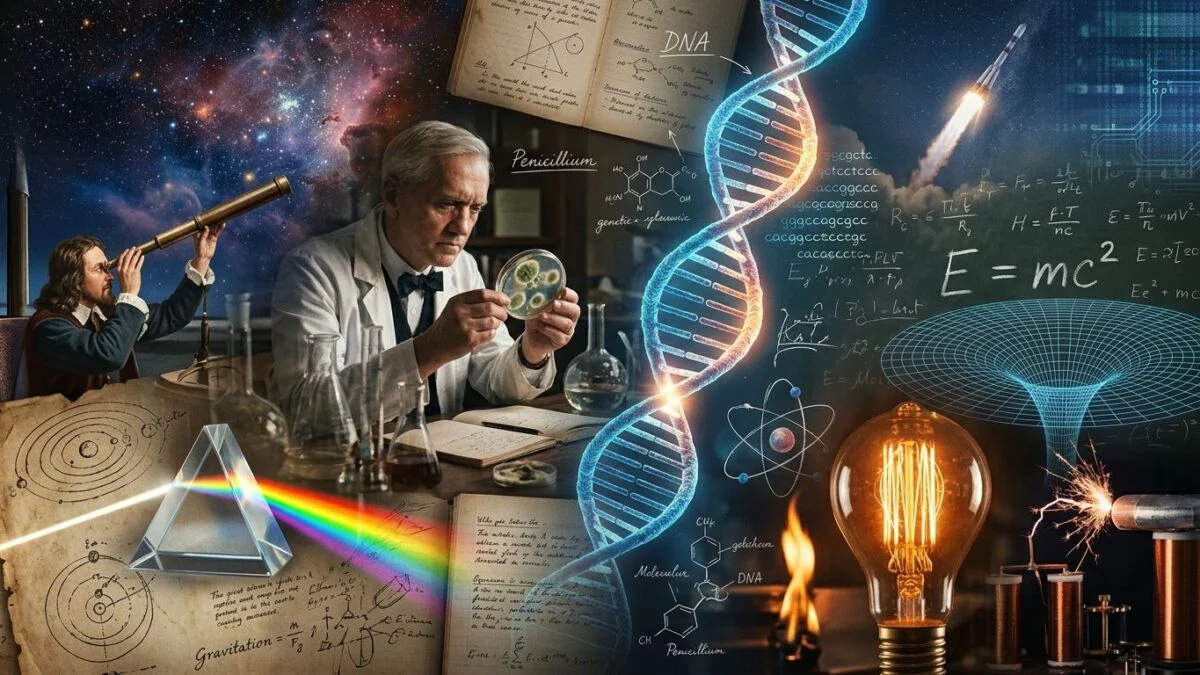
Science Discoveries That Changed the World
Science discoveries that changed the world span centuries and touch every aspect of daily life. They range from simple observations to complex theories that reshaped how we live. Because each breakthrough altered technology, health, or thought, understanding them helps us appreciate modern comforts. For example, the shift from candlelight to electric bulbs transformed night‑time activity. This article answers what those discoveries are and why they still matter.
When you hear a headline about a new invention, you might wonder if it will last. However, only a few inventions survive the test of time and become world‑changing. So, learning the criteria for lasting impact lets you separate hype from genuine progress. In fact, many people underestimate how early ideas still influence today’s gadgets. This guide will give you clear signs to look for.
We will start by defining what makes a discovery truly world‑changing. Then we will travel through history, highlighting early, modern, and recent breakthroughs. Next, we will point out common mistakes people make when judging scientific importance. Finally, we will show how to verify that a discovery really changed the world. By the end, you’ll have a practical framework for evaluating any new claim.
A closer look
To see a broader list of influential findings, you can explore the science discoveries archive on our site. That page groups many milestones by field, making it easy to compare their effects. It also links to deeper articles that explain each breakthrough in plain language. This resource complements the examples we discuss below. Remember that scientific impact can be subtle and may take decades to emerge. Therefore, we will also discuss how to avoid common pitfalls such as over‑valuing media hype. With these tools, you’ll be better equipped to spot the next discovery that could change the world.

Why science discoveries that changed the world matter today?
The short answer
What makes a discovery world‑changing?
A world‑changing discovery solves a problem that affects large numbers of people. Because it opens new possibilities, it often spawns entire industries. For instance, the understanding of electricity created power grids, appliances, and computers. In addition, the discovery usually survives rigorous testing and peer review, proving its reliability. Finally, it tends to be adopted across different cultures and economies.
How do we recognize lasting impact?
One clear sign is widespread adoption; millions or billions use the resulting technology. However, impact can also be indirect, such as a theory that guides future research. For example, the concept of DNA as genetic material paved the way for countless medical advances. Lasting impact often shows up in education curricula worldwide. As a result, the discovery becomes part of the shared knowledge base.
Which early discoveries set the stage for modern science?
Key details
Vaccination and public health
Edward Jenner’s work with cowpox showed that exposure could prevent deadly smallpox. This simple observation led to the first vaccine and sparked the field of immunology. As a result, countless lives have been saved through routine immunizations. Today, vaccination campaigns continue to protect populations from emerging diseases. The early success demonstrates how a single insight can reshape global health.
What 20th‑century breakthroughs reshaped technology?

Electricity and the light bulb
Thomas Edison’s practical incandescent bulb turned night into day for factories and homes. Because reliable lighting extended working hours, economies grew faster. In addition, the electric grid that followed powered countless other inventions, and the ripple effect reached everything from radios to computers. Consequently, electricity remains a foundation of modern infrastructure.
Penicillin and antibiotics
Alexander Fleming’s accidental discovery of penicillin opened the era of antibiotics. Because bacterial infections could now be treated, mortality rates dropped dramatically. The breakthrough also enabled complex surgeries that would have been too risky before. Over time, new antibiotics expanded the range of treatable diseases, and this medical revolution continues to save lives worldwide.
The structure of DNA
When James Watson and Francis Crick described DNA’s double helix, they revealed the blueprint of life. Because the structure explained how genetic information is stored and copied, it launched molecular biology. In practice, this led to genetic testing, forensic science, and biotechnology, and the discovery also sparked ethical debates that persist today. Its influence touches medicine, agriculture, and even computer science.
What common mistakes should we avoid when judging scientific impact?
Over‑valuing hype
Media coverage can make a new gadget seem revolutionary, even if it offers modest improvements. However, lasting impact requires more than flashy headlines. For example, many wearable devices generate excitement but rarely change daily habits. Therefore, always compare the claim with real‑world usage data, and this helps separate genuine breakthroughs from marketing hype.
Ignoring replication
Science relies on reproducibility; a single study is rarely enough to declare a discovery world‑changing. Because results can vary, other researchers must repeat experiments under different conditions. When replication fails, the original claim loses credibility. Consequently, look for a body of work that confirms the finding, and this practice safeguards against premature acclaim.
Assuming immediate benefit
Some discoveries take years or even decades before they affect everyday life. The internet, for instance, began as a research network before becoming ubiquitous. Similarly, early quantum theory took generations to produce practical devices. Therefore, patience is key when evaluating new research. Expecting instant transformation often leads to disappointment.
How can you verify that a discovery truly changed the world?
Look for widespread adoption
When millions or billions use a technology, its impact is evident. For example, smartphones dominate communication worldwide. Because adoption reflects real‑world utility, it serves as a strong indicator of change. Check market data, usage statistics, and cultural references to gauge reach, and this metric helps confirm lasting influence.
Check for cross‑disciplinary influence
A discovery that sparks advances in multiple fields shows deep significance. For instance, the mathematical tools of statistics now power data science, economics, and epidemiology. Because such cross‑pollination expands the original idea’s reach, it magnifies impact. Look for citations in diverse academic journals and industry reports, and this breadth often signals a world‑changing breakthrough.
Consider long‑term outcomes
Some effects only become clear after many years. Climate research, for example, informs policy decisions decades after the initial data collection. When a discovery continues to shape decisions, regulations, or daily habits, it proves its staying power. Review historical analyses and retrospective studies to assess durability. Long‑term relevance is the ultimate test of significance. Understanding science discoveries that changed the world helps you spot genuine progress and avoid false promises. Remember to look for widespread adoption, cross‑disciplinary influence, and long‑term outcomes while steering clear of hype, poor replication, and expectations of instant benefit. The next step is to apply this framework when you encounter new scientific claims, and to explore trusted resources for deeper insight.

Frequently Asked Questions
Can a discovery be important even if it takes centuries to be useful?
Yes; many ideas, such as the concept of zero or the germ theory, were only fully applied long after their initial formulation.
Why do some discoveries receive more media attention than others?
Media often favors stories with visual appeal, immediate relevance, or strong commercial potential, which can skew public perception.
How does public policy affect the spread of scientific breakthroughs?
Regulations, funding, and education programs can either accelerate adoption or create barriers, shaping how quickly a discovery reaches society.
Where can I find more examples of world‑changing discoveries?
Explore the Discover Magazine list, the Lifeboat article, or the Wikipedia timeline for a broader view.



[…] and RegulationTennis Rules Explained: Easy Guide to Scoring & Court Setupglobal politics ibScience Discoveries That Changed the WorldAI Detector: A Beginner’s Guide to Spotting Machine‑Generated ContentInside Food and Drink: A […]