
AI Agent vs Chatbot: What Is the Difference?
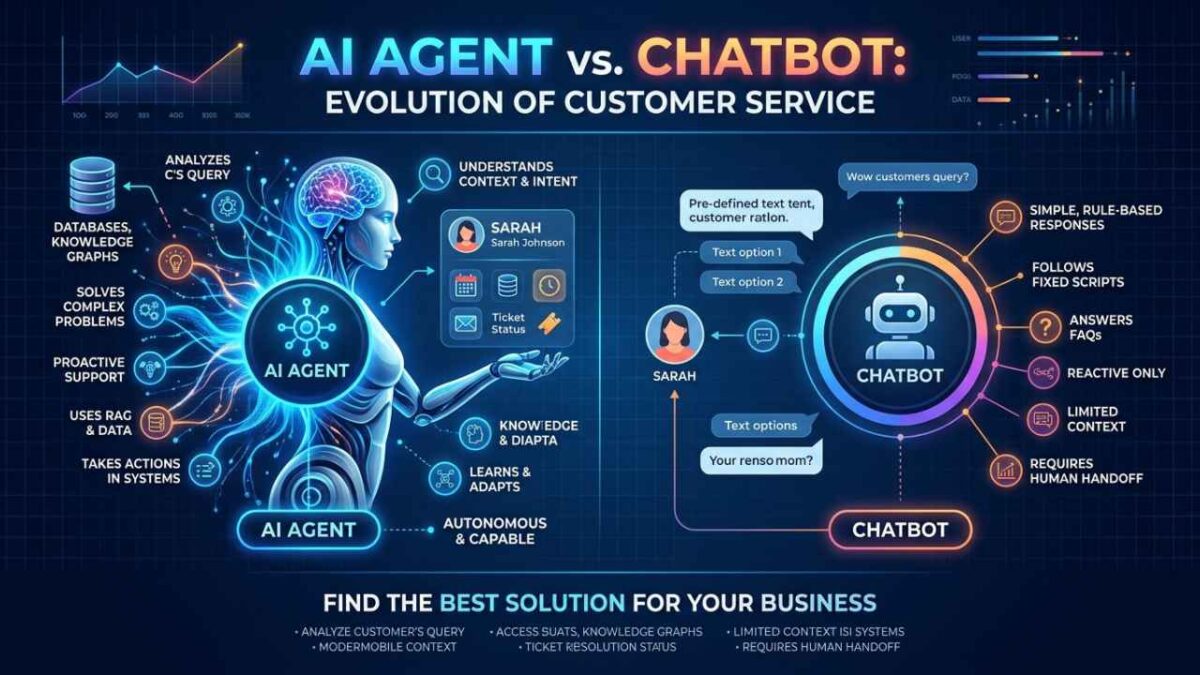
AI Agent vs Chatbot can be confusing because both technologies can understand natural language and communicate with users. However, they do not perform the same kind of work. A chatbot is mainly designed to have a conversation, answer questions, or provide information. An AI agent can go further by working toward a specific goal, making decisions, using tools, and completing tasks with less step-by-step guidance from the user.(cloud.google.com)
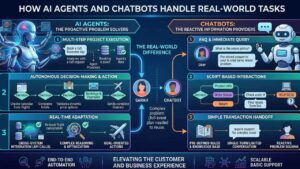
Traditional chatbots are mainly built to handle conversations and respond to predictable user requests. They may answer frequently asked questions, provide basic information, guide users through a fixed process, or direct them to the right support option. Rule-based chatbots follow predefined scripts and decision paths, while modern AI chatbots can understand more natural language and keep track of conversation context. However, their main role remains responding to the user rather than independently planning and completing a larger task. (IBM)
An AI agent is designed to work toward a specific goal rather than simply respond to a single question. It can break a larger task into smaller steps, decide what information or tools it needs, and take actions based on the results. For example, an agent may research information, use an external tool, analyze the results, and then complete the next step without requiring the user to guide every action. This ability to plan and perform multi-step tasks is one of the main differences between AI agents and traditional chatbots. (cloud.google.com)
This difference matters more in 2026 because businesses are using AI for more than basic customer conversations. Companies are exploring AI agents for tasks such as research, customer support, data handling, workflow automation, and software operations. As these systems gain access to business tools and data, the choice between a chatbot and an AI agent can affect how much work AI can handle, how much human oversight is needed, and what security controls are required.
In this guide, we will look closely at AI Agent vs Chatbot and explain how their capabilities differ in real-world situations. We will compare how they handle conversations, make decisions, use tools, and complete tasks. We will also look at practical examples, common use cases, limitations, security concerns, and the situations where a chatbot or an AI agent may be the better choice.
AI Agent vs Chatbot: What Is the Main Difference?
What Is an AI Chatbot?
An AI chatbot is a software system designed to communicate with people through text or voice. It uses artificial intelligence to understand a user’s message and generate a relevant response. Basic chatbots may follow fixed rules, while modern AI chatbots can understand natural language, remember conversation context, and handle more flexible questions. They are commonly used for customer support, answering questions, providing information, and guiding users through simple tasks. Unlike an AI agent, a chatbot is usually focused on the conversation itself rather than independently planning and completing a complex goal.
What Is an AI Agent?
An AI agent is an AI-powered software system that can work toward a specific goal and perform tasks with a certain level of autonomy. Instead of only generating an answer, an agent can understand the goal, break a complex task into smaller steps, use connected tools or external data, and take actions based on what it finds. For example, an AI agent could gather information, analyze it, use another software tool, and continue working toward the requested result without needing the user to give instructions for every step. (Google Cloud)
Unlike a simple chatbot, an AI agent is built around reasoning, planning, tool use, and action. The level of autonomy can vary between systems, so not every product described as an “AI agent” can independently complete every task. Human supervision, permissions, and system rules can still be important, especially when an agent has access to business data or external applications. (Google Cloud)
AI Agent vs Chatbot: 7 Key Differences
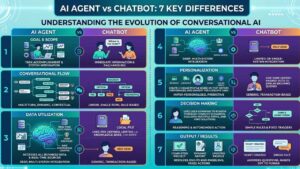
1. Conversation vs Goal Completion
AI chatbots are mainly designed to communicate with users. They answer questions, explain information, and help users through a conversation. An AI agent has a broader purpose. Instead of stopping after giving an answer, it can work toward a specific goal and take actions needed to complete that task. This difference becomes important when AI is used for more than simple conversations, especially in applications where users expect the system to do something rather than only tell them something. For example, AI platforms such as Character.AI show how conversational AI can also involve user safety, age assurance, and privacy considerations beyond a basic question-and-answer exchange. Why Does Character.AI Require Camera Scan? (nexavice)
2. Single Response vs Multi-Step Tasks
A chatbot will often provide a response based on the user’s request and the information available to it. An AI agent can handle a more complex task by breaking it into several steps and working through them in sequence. For example, an agent could collect information, analyze it, use a connected tool, and then produce a final result. This multi-step approach is also why it is useful to understand the difference between general AI chatbots and specialized AI tools. Google NotebookLM, for example, focuses on working with user-provided sources, allowing people to ask questions, generate summaries, and work with documents inside a focused research environment. NotebookLM Reviews: Is Google AI Tool Worth It? (nexavice)
3. Limited Actions vs Tool Use
One of the biggest differences is the ability to use external tools. A chatbot may provide instructions or information, but an AI agent can potentially connect with software, databases, APIs, or other systems to perform actions. This gives agents more power, but it also increases the computing, infrastructure, security, and energy requirements behind advanced AI systems. As AI workloads grow, data centers need more electricity and computing capacity, making the broader AI energy crisis an important part of the technology discussion. AI Energy Crisis: Power Demand, Data Centers & Grid Strain (nexavice)
4. User Direction vs Greater Autonomy
A chatbot usually depends more on the user to guide the conversation and decide what should happen next. The user asks a question, provides another instruction, and then receives a response. An AI agent can operate with greater autonomy after receiving a goal. It may decide which steps are needed, select the right tools, and continue working without requiring instructions for every action. However, autonomy does not mean unlimited control. Important systems may still require human approval before an agent takes sensitive or irreversible actions. (Google Cloud)
5. Fixed Workflows vs Dynamic Planning
Traditional chatbots and automated systems often work through predefined conversation paths or fixed workflows. These systems can be effective when the same type of request happens repeatedly. AI agents are more flexible because they can create or adjust a plan based on the task and the information they receive during execution. If one step produces an unexpected result, an agent can potentially change its approach and continue toward the larger goal instead of simply stopping at a fixed response. (Google Cloud)
6. Information Delivery vs Task Execution
A chatbot is often useful when the user mainly needs information. It can explain a product, answer a question, summarize content, or guide someone through a process. An AI agent can take the next step and perform actions using connected tools or systems. For example, instead of only explaining how a business report is prepared, an agent could collect information from connected sources, process the data, prepare the report, and send it for human review. This shift from providing information to executing tasks is a major reason businesses are exploring agentic AI for complex workflows. (Google Cloud Documentation)
7. Lower Complexity vs Higher Operational Complexity
AI chatbots are generally simpler to deploy when their role is limited to conversation and information delivery. AI agents can require much more infrastructure because they may need memory, tool access, external data, permissions, monitoring, and systems that can manage long-running tasks. Their greater capabilities also create additional security and governance challenges. For example, an agent that can read business data or trigger API calls needs carefully controlled permissions and monitoring. This makes AI agents more powerful for complex work, but also more difficult to build, manage, and secure than a basic chatbot. (Google Cloud)
How AI Agents and Chatbots Handle Real-World Tasks
The difference between chatbots and AI agents becomes much clearer when they are used for real-world tasks. A chatbot can answer a customer’s question, explain a product, provide an order update, or guide someone through a support process. An AI agent can handle a larger workflow by understanding the request, gathering information, using connected systems, taking approved actions, and continuing until the task reaches a useful outcome. For example, modern customer-service agents can review account information, check policies, update requests, and confirm a resolution instead of only replying with information. (Zendesk)
Customer Support
In customer support, a chatbot may answer common questions such as “Where is my order?” or “What is your return policy?” An AI agent can go further by checking the customer’s order record, reviewing the relevant policy, updating information when permitted, and escalating the issue to a human when the situation requires judgment. This makes agents more useful for multi-step support tasks, while chatbots remain effective for simple and repetitive questions. (HubSpot Blog)
Personal Assistance
AI agents are also moving into everyday personal tasks. In September 2026, Meta launched its Muse personal AI agent in the United States. According to reporting from the Associated Press, Muse is designed to help with tasks such as managing schedules, shopping, planning, drafting and sending emails, filling out forms, and other activities. This illustrates how an AI agent can move beyond conversation and interact with digital services on a user’s behalf. (AP News)
Business Workflows
Businesses can use AI agents for workflows that involve several connected systems. An agent might collect information from company databases, review documents, prepare a response, update a record, and then send the task to a person for approval. This type of workflow is different from a chatbot simply answering a question because the system is working toward an outcome rather than stopping after generating text. Research into production AI agents is already examining these kinds of real customer-support deployments and human-in-the-loop controls. (arXiv)
Research and Information Tasks
Chatbots are useful when someone needs a quick explanation, summary, or answer. An AI agent can handle a more involved research task by gathering information from multiple sources, organizing the findings, and using available tools to complete different stages of the work. The important distinction is not simply how much text the system can generate. It is whether the system can act on the information and continue working toward a defined goal. (Zendesk)
The Future of AI Agents and Chatbots
The future of AI is likely to include both chatbots and AI agents, but their roles may become more distinct. Chatbots will continue to be useful for conversations, quick answers, customer support, and information access. AI agents, meanwhile, are moving toward more complex workflows where they can use tools, interact with software, and complete tasks with less human direction. In 2026, businesses are increasingly exploring agentic AI for real operational work, while security and governance are becoming equally important as these systems gain more access and autonomy. (Microsoft)
AI agents may also become more deeply connected to the software people already use. Instead of opening several applications and completing each step manually, users may increasingly give an AI system a goal and allow it to coordinate the required actions across different services. This could make AI more useful for business operations, research, customer service, and personal productivity. (TechRadar)
However, greater autonomy will not automatically make AI better. An agent that can access company data, send information, or make changes to a system also needs clear permissions, monitoring, and human oversight. Recent developments in 2026 show growing attention to these issues, including new efforts to improve security and control for autonomous AI systems. (Newswire)
Chatbots are therefore unlikely to simply disappear. Instead, many future AI products may combine conversational interfaces with agentic capabilities. A user could talk to an AI in the same way they use a chatbot, while the system works in the background like an agent to complete approved tasks. The real shift may not be from chatbots to agents, but from AI that mainly responds to AI that can respond, reason, and act.
Frequently Asked Questions About AI Agent vs Chatbot
What is the difference between an AI agent and a chatbot?
An AI chatbot is mainly designed to communicate, answer questions, and provide information. An AI agent can work toward a goal by planning steps, using tools, and taking actions. The main difference is that an agent can handle more complex tasks with greater autonomy.
Is ChatGPT a chatbot or an AI agent?
ChatGPT is primarily a conversational AI system, but it can also provide agent-like capabilities when it is connected to tools and can perform actions. Therefore, calling every version of ChatGPT simply a chatbot would not describe all of its capabilities.
Can an AI agent replace a chatbot?
Not necessarily. Chatbots remain useful for simple customer questions, information requests, and guided conversations. AI agents are more suitable for tasks that require multiple steps, tool use, or actions. In many systems, a chatbot-style interface and an AI agent can work together.
Are AI agents more expensive than chatbots?
They can be. An AI agent may require additional infrastructure, tool integrations, data access, monitoring, and security controls. The actual cost depends on the complexity of the system, how often it runs, the AI models it uses, and the number of external services it can access.
Can AI agents use external tools?
Yes. A major capability of many AI agents is the ability to interact with external tools, APIs, databases, software applications, or other services. These connections allow an agent to do more than generate a response, although access should be controlled carefully.
Are AI agents safe?
AI agents can be useful, but their safety depends heavily on how they are designed and controlled. Giving an agent access to sensitive information or external systems can create additional risks. Strong permissions, monitoring, human approval for sensitive actions, and security protections can help reduce those risks.
Which is better for customer service, an AI agent or chatbot?
It depends on the type of customer request. A chatbot can be a good choice for frequently asked questions and simple support conversations. An AI agent can be more useful when a request requires several steps, such as checking information across systems and completing an approved action. In some businesses, both can be used together.
Conclusion
The main difference between an AI agent and a chatbot is what they are designed to accomplish. A chatbot mainly focuses on conversation, answering questions, and delivering information. An AI agent can take a goal, plan the required steps, use connected tools, and perform actions with a greater level of autonomy.
Neither technology is automatically better. Chatbots remain useful for simple and predictable interactions, while AI agents are better suited to complex tasks that require planning and execution. As AI continues to develop, the two may increasingly work together, giving users a conversational way to interact with systems that can also take meaningful actions.

[…] Breaking What Is an AI Design Agent for Creative Workflows?AI Agent vs Chatbot: 7 Key Differences Explainedhow old is Tom Cruise? Career Age & Full TimelineKarsten Warholm: World Record, Career & […]
[…] generation reflects the shifts seen in natural language tools over recent years. Reviewing an AI agent vs chatbot comparison shows how current software handles complex chains of tasks rather than single queries. […]