
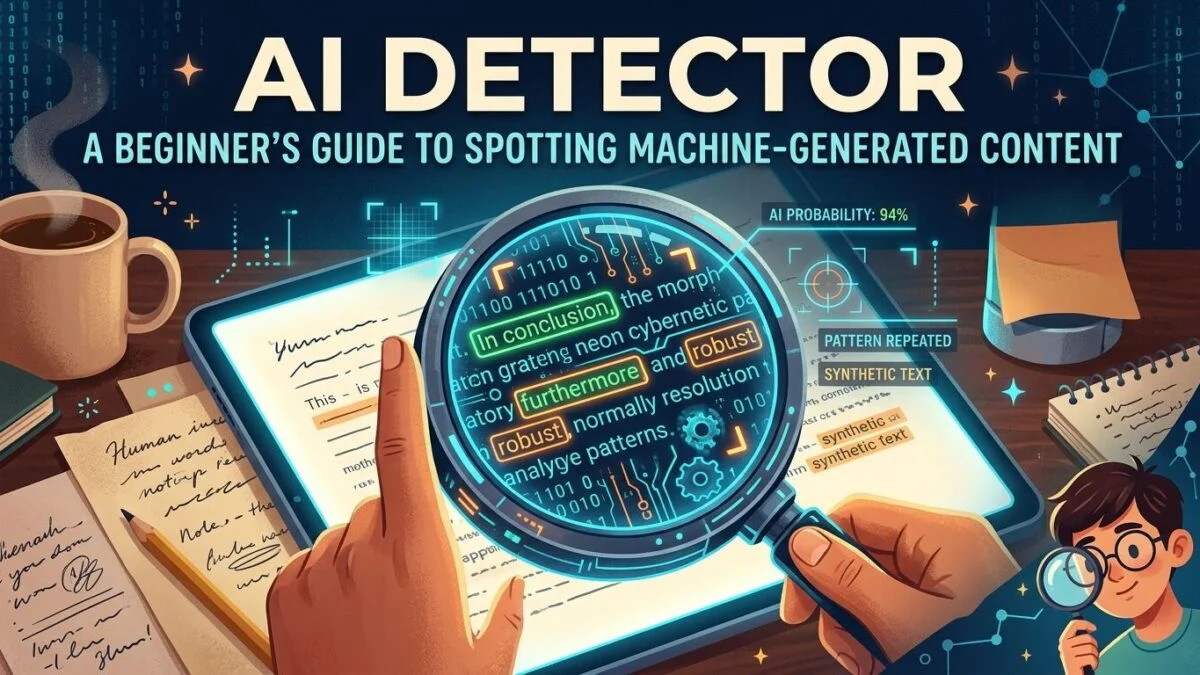
AI Detector: A Beginner’s Guide to Spotting Machine‑Generated Content
Many people assume that any text that looks polished must be written by a human. In fact, an ai detector can tell you whether a piece of writing was likely generated by a machine. This article explains what those tools do, why they matter, and how you can start using them today. You’ll discover practical steps, common pitfalls, and where to go after you master the basics. By the end, you’ll feel confident deciding if a paragraph needs a human touch.
First, it helps to understand that AI detectors analyze patterns that differ from typical human phrasing. They look at word choice, sentence length, and statistical quirks that large language models often produce. Because these patterns are subtle, a good detector can flag suspicious sections without reading the entire document. However, no tool is perfect; they provide clues rather than absolute proof.
Second, many free detectors are available online, and most of them work directly in a browser. You simply paste the text and receive a score indicating the likelihood of AI involvement. Some services also let you upload documents for batch analysis. While the user experience varies, the core idea stays the same: compare the input against known AI signatures.
A closer look
Third, beginners often misuse scores by treating them as binary verdicts. A high probability doesn’t guarantee AI authorship, and a low score doesn’t guarantee a human wrote it. Instead, treat the result as a signal that warrants further review. Combining detector output with your own judgment leads to the most reliable conclusions. Finally, learning how to interpret detector results opens doors to better content moderation, academic honesty, and brand safety. Whether you’re a teacher, editor, or marketer, knowing when to trust a piece of text is a valuable skill. The sections below walk you through the basics, first steps, choices, mistakes, and next‑level resources.

What Is an AI Detector and How Does It Work?

What Types of Content Can an AI Detector Analyze?
AI detectors aren’t limited to plain text; many can also evaluate code snippets, social media posts, and even images. For example, the DeepAI AI image detector examines visual patterns that suggest synthetic generation. Because the underlying models differ, each detector focuses on the features most relevant to its domain. Consequently, a text‑only detector may miss clues in an image, while an image detector will ignore linguistic cues. Understanding this scope helps you choose the right tool for the job.
How Do AI Detectors Identify Machine‑Generated Patterns?
Most detectors use statistical models trained on large corpora of human and AI‑generated text. They calculate the probability that a given sequence matches known AI signatures. For instance, they may flag unusually uniform sentence length or repetitive phrasing. As a result, the output is often a confidence score rather than a simple yes/no answer. This approach mirrors how plagiarism checkers compare documents against a database, but focuses on stylistic fingerprints instead.
How Can I Start Using an AI Detector for My Writing?
Which Free Tools Are Good for First Tests?
Several web‑based detectors let you try the technology without paying. QuillBot’s AI content detector offers a quick paste‑and‑check interface, while ZeroGPT provides a detailed breakdown of the score. Both tools are easy to access and require no installation. Because they’re free, they’re ideal for experimenting with short excerpts before committing to a paid solution.
How Do I Run a Simple Detection Scan?
Start by copying the text you want to examine. Then paste it into the detector’s input box and click the analyze button. Within seconds, the service returns a percentage indicating the likelihood of AI authorship. If the score is high, review the passage for repetitive structures or overly formal language. You can also run the same text through a second detector to compare results, which improves confidence in the assessment.
Which Features Should I Look for When Choosing an AI Detector?
Should I Prefer Open‑Source or Commercial Detectors?
Open‑source detectors give you full visibility into the algorithms, which can be reassuring for privacy‑focused users. Commercial options often provide larger training datasets and more frequent updates, which may improve accuracy. If you need to process sensitive documents, an open‑source solution that runs locally might be safer. Conversely, a cloud‑based commercial tool can offer faster results for high‑volume workloads.
What Accuracy Metrics Matter Most?
When evaluating a detector, look for precision and recall values published by the developer. Precision tells you how often a high score truly means AI‑generated content, while recall indicates how many AI pieces the tool catches. A balanced detector will have both numbers reasonably high. Keep in mind that real‑world performance can differ from benchmark results, so testing with your own data is essential.
What Common Mistakes Do Beginners Make with AI Detectors?
Why Do Users Trust Every Result Without Verification?
It’s easy to treat a detector’s score as a definitive verdict, especially when the interface looks authoritative. However, AI models evolve, and detectors can lag behind new generation techniques. Therefore, a high score should prompt a closer manual review rather than an automatic rejection. Combining the tool’s output with your own expertise yields the most reliable outcome.
How Can Over‑Reliance on Scores Mislead?
Relying solely on a numeric score can cause you to overlook context. For instance, a technical manual may naturally contain repetitive phrasing, leading to a false positive. Conversely, a creatively written piece might mimic AI patterns, resulting in a false negative. Always consider the purpose, audience, and genre of the text before drawing conclusions from the detector alone.
Where Can I Go Next After Learning the Basics of AI Detection?
What Advanced Techniques Expand Detection Skills?
Beyond simple score checks, you can explore ensemble methods that combine multiple detectors for a consensus view. Some researchers also use stylometric analysis, which examines deeper linguistic features like syntax trees. These approaches require more technical knowledge but can increase confidence in high‑stakes scenarios such as academic integrity investigations. Staying up‑to‑date is important because AI generation methods improve rapidly. Websites like AI vs. Human writing comparisons provide regular case studies that illustrate new detection challenges. The Google Flow page offers insights into workflow automation that can incorporate detection steps. For broader AI understanding, the article on AI agents versus chatbots clarifies how different models behave, which helps you anticipate future detection needs. Finally, keep an eye on open‑source communities where new detection algorithms are shared.

Frequently Asked Questions
Can an AI detector catch every piece of machine‑generated text?
No, detectors provide probabilities, not guarantees, and they’re most reliable when used alongside human judgment.
Do AI detectors work on languages other than English?
Some tools support multiple languages, but accuracy varies. Check the provider’s language list before relying on results.
Is it legal to run an AI detector on someone else’s content?
Generally, analyzing publicly available text is permissible, but always respect privacy policies and copyright rules.
How often should I re‑evaluate the detector I use?
Because AI models evolve, review your detector’s performance at least once a year or after major model releases.
What should I do if a detector flags my own work?
Review the highlighted sections, adjust overly uniform phrasing, and consider adding personal anecdotes to increase human‑like variability.
Conclusion
Understanding how an AI detector works and how to interpret its scores is the single most valuable skill for anyone dealing with digital content today. While no tool can replace careful reading, a well‑chosen detector can save time and highlight potential issues. Remember to verify results, choose features that match your needs, and keep learning as the technology evolves. For the next step, explore advanced ensemble methods or join online forums where experts share the latest detection tricks.




[…] Related reading: AI Detector: A Beginner’s Guide to Spotting Machine‑Generated Content […]